
Machine Learning vs AI vs Deep Learning: Understanding the Differences
Published by The Consultancy World | AI Strategy Experts | Last Updated: April 2026
Reading Time: 16–20 minutes
Level: Beginner to Intermediate
Audience: Business Leaders, Technology Decision-Makers
The AI Foundations Library: Lesson 3 of 8
AI Hierarchy: Executive Summary
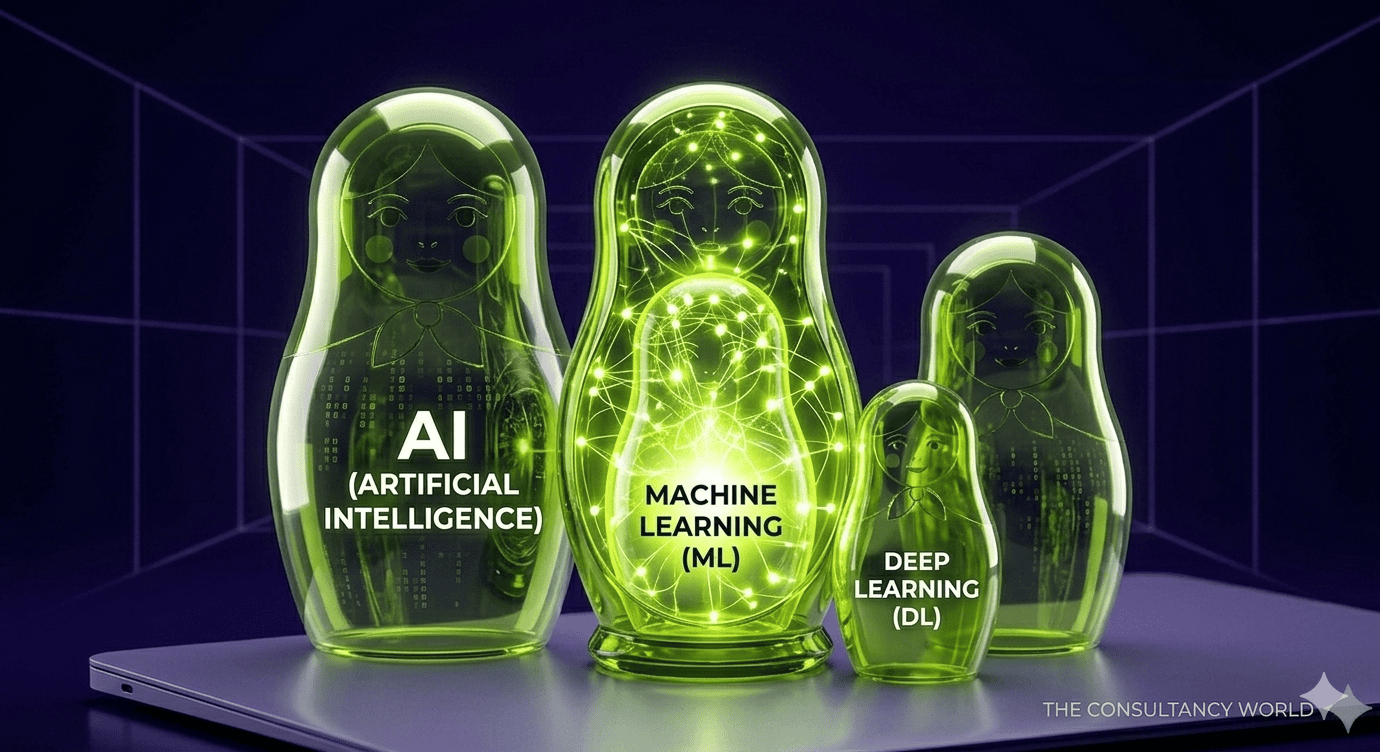
1. Artificial Intelligence: The Outer Shell
Artificial Intelligence is the broadest category. It refers to any technique that enables computers to mimic human intelligence.
The Reality: Much of what is marketed as "AI" today is actually sophisticated automation or "If/Then" logic.
Executive Note: In this outer layer, you are buying efficiency. It is the "marketing term" for the entire field of automation.
2. Machine Learning (ML): The Engine of ROI
Machine Learning is a subset of AI that uses statistical methods to enable machines to improve at tasks with experience. This is where most business value is generated in 2026.
How it works: Instead of being programmed with specific rules, the system is trained on vast amounts of data to identify patterns and make predictions.
The Value: This is the layer that predicts customer churn, optimises supply chains and identifies fraudulent transactions. Your 2026 ROI will primarily come from here.
3. Deep Learning (DL): The Core Powerhouse
Deep Learning is a specialised subset of Machine Learning based on artificial neural networks. It is the technology behind the "magic" of Image Recognition and Large Language Models (like ChatGPT).
The Requirement: Deep Learning requires the biggest data sets and the largest hardware budgets.
* The Value: It handles unstructured data - like video, human speech and complex imagery - that traditional Machine Learning cannot process.
The "Matryoshka" Strategic View
Think of these as Russian Dolls. You cannot have Deep Learning without Machine Learning, and both sit inside the broad world of AI.
Low Complexity / Low Cost: General AI Automation.
Medium Complexity / High ROI: Targeted Machine Learning.
High Complexity / High Cost: Generative Deep Learning.
Executive Takeaway
Don't buy a Deep Learning 'Ferrari' when a Machine Learning 'Workhorse' is what your data actually supports. Identifying which layer of the hierarchy your business problem sits in is the first step to avoiding wasted investment.