
What Is Artificial Intelligence? A Business Leader's Guide
Artificial Intelligence (AI) is a branch of computer science that enables machines to perform tasks that traditionally require human intelligence, including learning from experience, recognising patterns, making decisions, and understanding language. For business leaders, AI represents a fundamental shift in how organisations operate—moving from rule-based automation to systems that can analyse data, adapt to new information, and improve their performance over time without explicit programming for every scenario.
This guide provides business leaders with a clear, practical understanding of what AI actually is, how it works, and why it matters for your organisation in 2025 and beyond.

Understanding Artificial Intelligence: The Core Definition
Artificial Intelligence refers to computer systems designed to perform tasks that would normally require human cognitive abilities. Unlike traditional software that follows predetermined rules ("if this happens, then do that"), AI systems can:
- Learn from data and experience without being explicitly programmed for every situation
- Identify patterns and relationships in complex datasets that humans might miss
- Make predictions and decisions based on probability and historical information
- Adapt their behaviour as they encounter new information
- Understand and process human language in context
- Recognise images, speech, and other sensory inputs with high accuracy
The Restaurant Analogy
Think of traditional software as following a recipe precisely - every time you make a dish, you follow the exact same steps. AI, however, is more like an experienced chef who has cooked thousands of meals. They understand ingredients, techniques, and flavours well enough to adapt recipes, create new dishes, and adjust based on what's available. They've learned through experience, not just instructions.
How Does AI Actually Work? The Technical Foundation Explained Simply
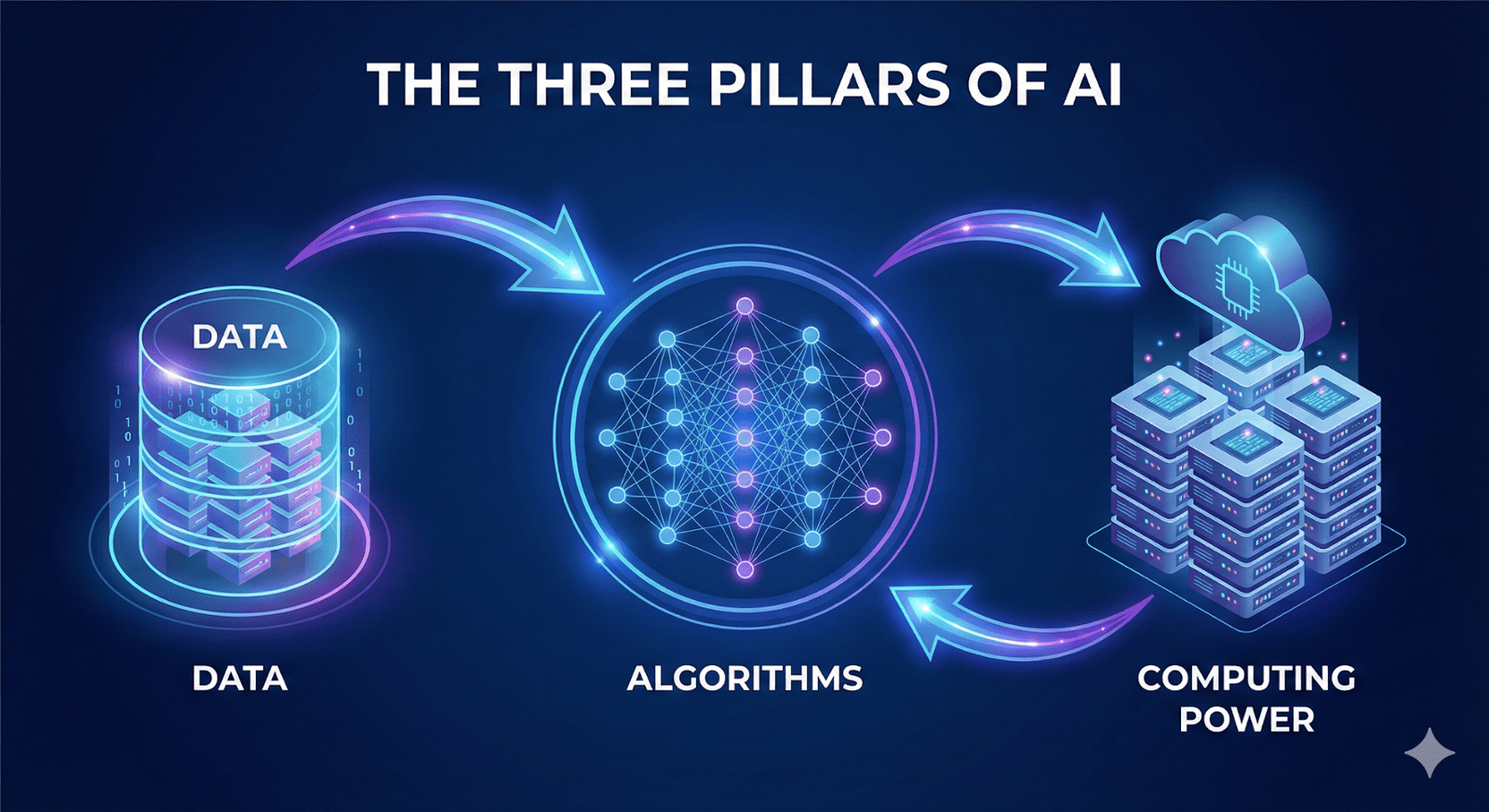
AI systems operate on three fundamental components that business leaders should understand:
1. Data (The Fuel)
AI systems learn from data—examples, patterns, and information fed into them. The quality and quantity of this data directly impacts the AI's performance. For business applications, this might include:
- Historical sales records
- Customer interaction logs
- Financial transactions
- Email communications
- Product inventories
- Market data
The more relevant, high-quality data an AI system has access to, the better it can perform its designated tasks.
2. Algorithms (The Engine)
Algorithms are mathematical instructions that process data to identify patterns and make decisions. Modern AI uses sophisticated algorithms called "neural networks" that loosely mirror how human brains process information—connecting millions of data points to find meaningful relationships.
3. Computing Power (The Infrastructure)
AI requires significant computational resources to process large datasets and run complex calculations. Cloud computing has made this accessible to organisations of all sizes, eliminating the need for expensive on-premise infrastructure.
The Three Types of AI: Understanding the Spectrum
1. Artificial Narrow Intelligence (ANI) - What Exists Today
Also called "Weak AI," this is what every business uses today. ANI systems are designed to perform specific tasks exceptionally well but cannot transfer that knowledge to other domains.
Business Examples:
- Email spam filters that identify unwanted messages
- Recommendation engines suggesting products customers might purchase
- Chatbots handling customer service enquiries
- Fraud detection systems flagging suspicious transactions
- Inventory forecasting tools predicting stock requirements
Key Characteristic: Brilliant at one thing, incapable of anything else. A chess-playing AI cannot suddenly write poetry or analyse financial statements.
2. Artificial General Intelligence (AGI) - The Hypothetical Future
AGI refers to AI systems with human-level intelligence that can understand, learn, and apply knowledge across any domain—essentially a digital mind as flexible and capable as a human's.
Current Status: AGI does not exist today. Experts disagree on whether it will emerge in 10, 50, or 100+ years, if ever.
Why Business Leaders Should Know About It: Understanding the difference between today's narrow AI and theoretical AGI prevents unrealistic expectations and helps you evaluate vendor claims critically.
3. Artificial Superintelligence (ASI) - Science Fiction Territory
ASI describes hypothetical AI that surpasses human intelligence across all domains. This remains firmly in the realm of speculation and long-term research.
For practical business planning in 2025, focus exclusively on Artificial Narrow Intelligence (ANI)—the technology that exists, works, and delivers measurable ROI today.
Why AI Matters for Your Business: The Strategic Imperative
AI is not simply another technology trend. It represents a fundamental shift in competitive dynamics across virtually every industry. Here's why AI matters strategically:
1. Operational Efficiency at Scale
AI automates repetitive cognitive tasks that previously required human intervention, freeing your team to focus on strategic, creative, and relationship-driven work. Unlike traditional automation, AI handles variability and complexity—processing diverse customer enquiries, analysing unstructured documents, or adapting to changing market conditions.
Real Impact: Organisations implementing AI for operational tasks report 20-40% time savings on routine processes, according to McKinsey's 2024 State of AI report.
2. Enhanced Decision-Making
AI analyses vast amounts of data to surface insights, predict outcomes, and recommend actions faster and more accurately than manual analysis. This moves organisations from reactive to proactive strategy.
Real Impact: AI-powered forecasting improves accuracy by 10-20% compared to traditional statistical methods in sectors like retail, manufacturing, and financial services.
3. Personalisation at Scale
AI enables businesses to deliver individualised customer experiences to thousands or millions of customers simultaneously—something impossible with human resources alone.
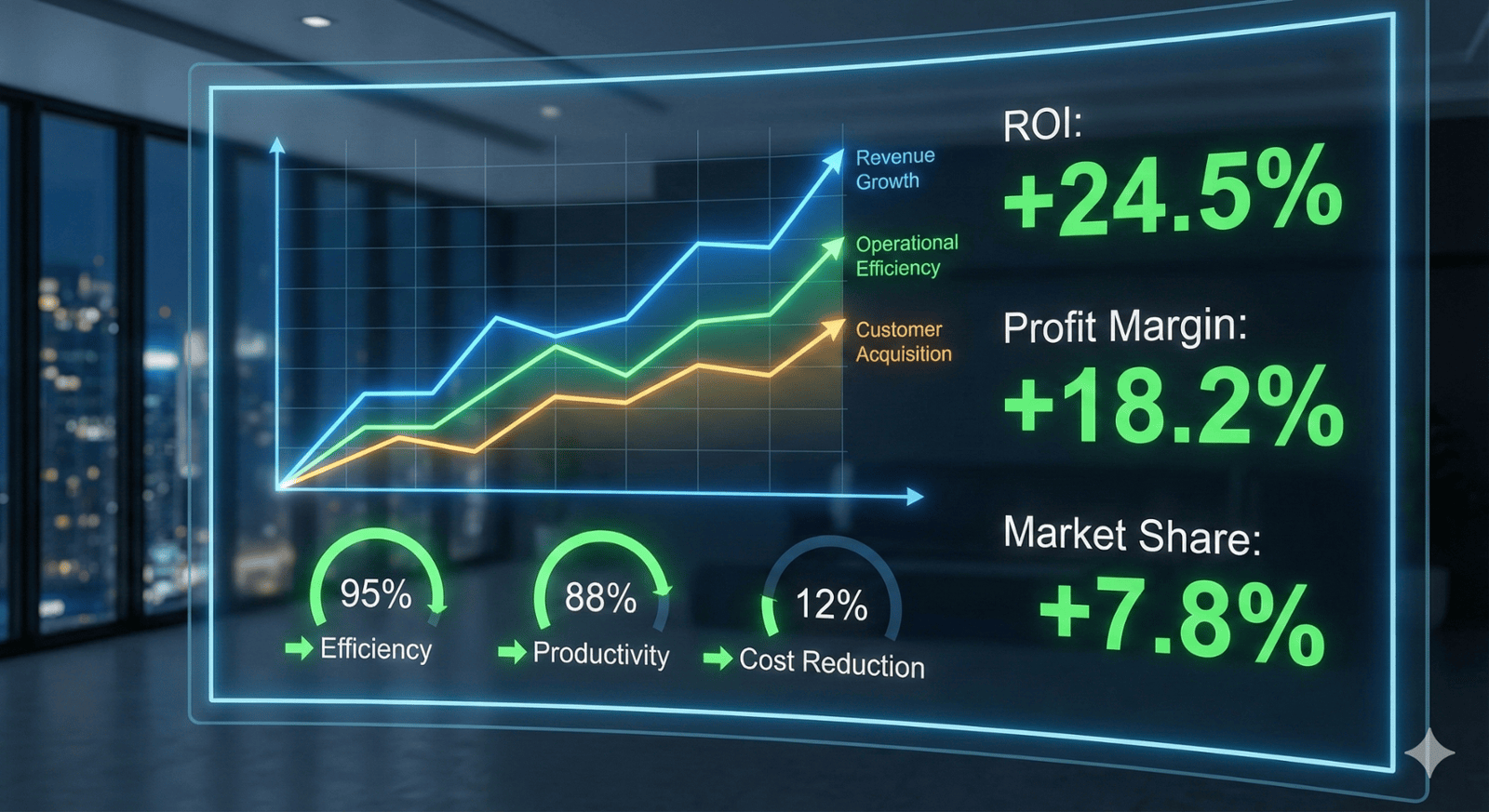
Real Impact: Personalised marketing campaigns powered by AI typically generate 5-8x higher ROI than generic campaigns, according to research from Salesforce.
4. Competitive Advantage
Early adopters of AI in specific domains gain significant advantages: faster response times, deeper customer insights, operational cost reduction, and the ability to offer services that competitors cannot match.
Real Impact: A 2024 PwC study found that companies with mature AI strategies report 15-25% higher profit margins than industry peers.
Is your organisation ready to harness AI's potential?
Predictive Analytics
Many business leaders recognise AI's importance but feel uncertain about where to start. That's exactly why we created our AI Readiness Assessment—a complimentary consultation that identifies your highest-impact opportunities for AI integration.
In just 45 minutes, we'll help you:
✓ Identify specific processes where AI can deliver immediate ROI
✓ Assess your organisation's AI readiness
✓ Understand realistic timelines and investment requirements
✓ Receive a preliminary roadmap tailored to your business
No pressure. No sales pitch. Just expert guidance to help you understand your AI opportunities.
What AI Is NOT: Clearing Common Misconceptions
Understanding what AI cannot do is as important as understanding its capabilities:
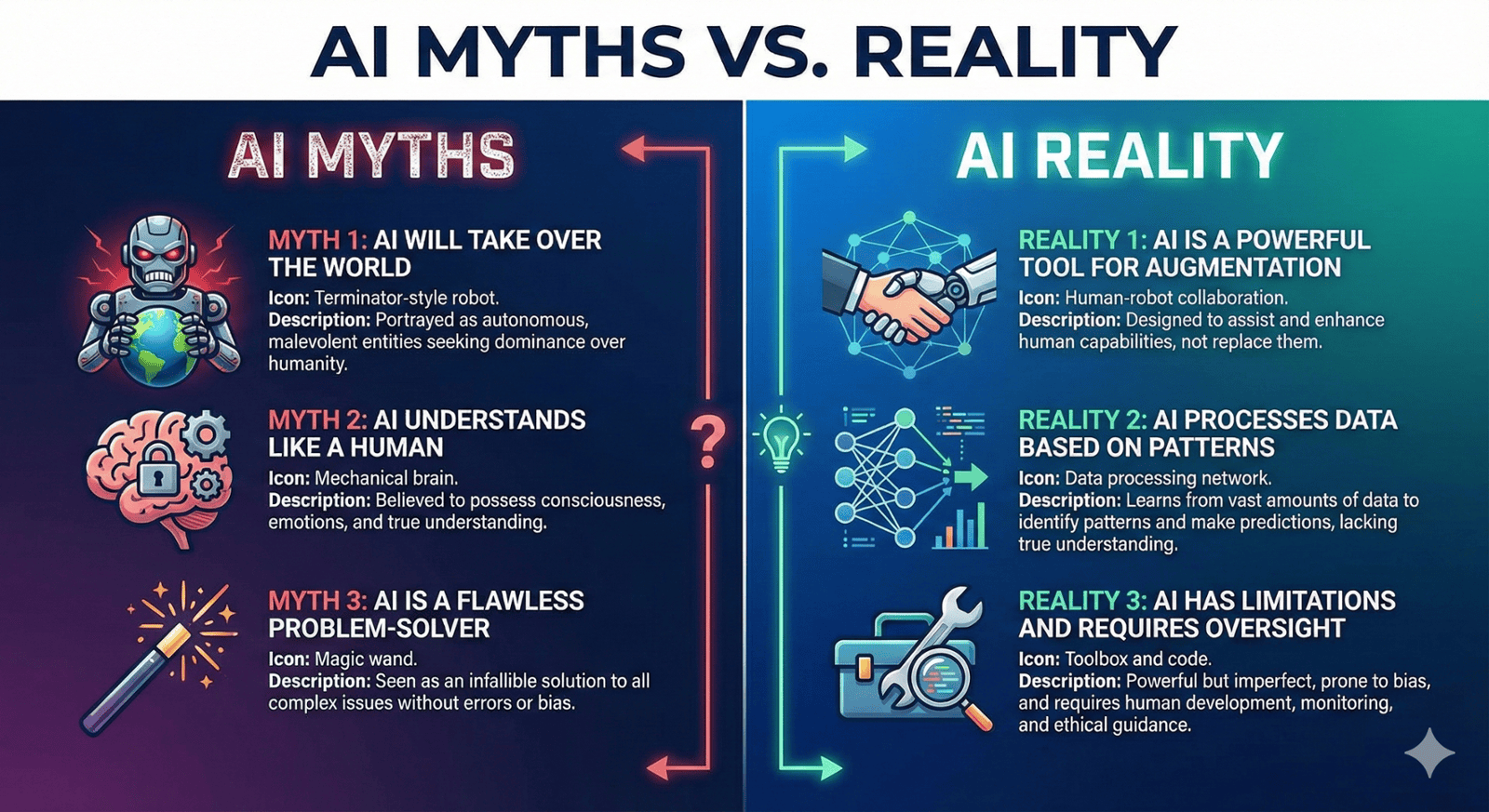
AI Is Not Magic
AI systems require quality data, proper configuration, ongoing maintenance, and realistic expectations. They don't automatically solve problems without strategic planning and implementation effort.
AI Is Not Always Right
AI systems make mistakes. They can be biased based on their training data, make incorrect predictions, and occasionally produce nonsensical outputs. Human oversight remains critical.
AI Is Not Conscious or Self-Aware
Current AI systems do not have consciousness, emotions, desires, or independent goals. They are sophisticated pattern-matching and prediction engines, not sentient beings.
AI Cannot Replace Human Judgment Entirely
AI excels at data processing, pattern recognition, and optimisation. It struggles with:
- Ethical considerations and moral reasoning
- Creative strategy and innovation
- Complex stakeholder relationship management
- Situations requiring empathy and emotional intelligence
- Novel problems it hasn't encountered in training data
The most effective business applications combine AI's analytical power with human judgment, creativity, and strategic thinking.
AI Is Not "Plug and Play"
Successfully implementing AI requires:
- Clean, relevant data
- Clear business objectives
- Proper integration with existing systems
- Team training and change management
- Ongoing monitoring and optimisation
The Current State of Business AI in 2025
As of December 2025, AI adoption in business has moved from experimental to mainstream, though maturity levels vary significantly:
Widespread Adoption Areas:
Emerging Applications:
Key Trend: Generative AI
Since 2023, generative AI (systems that create new content—text, images, code) has dramatically lowered the barrier to entry. Tools like ChatGPT, Claude, and Microsoft Copilot allow businesses to leverage AI capabilities without custom development or data science teams.
This democratisation means that strategic planning and smart implementation matter more than technical resources.
How AI Learns: Machine Learning Fundamentals
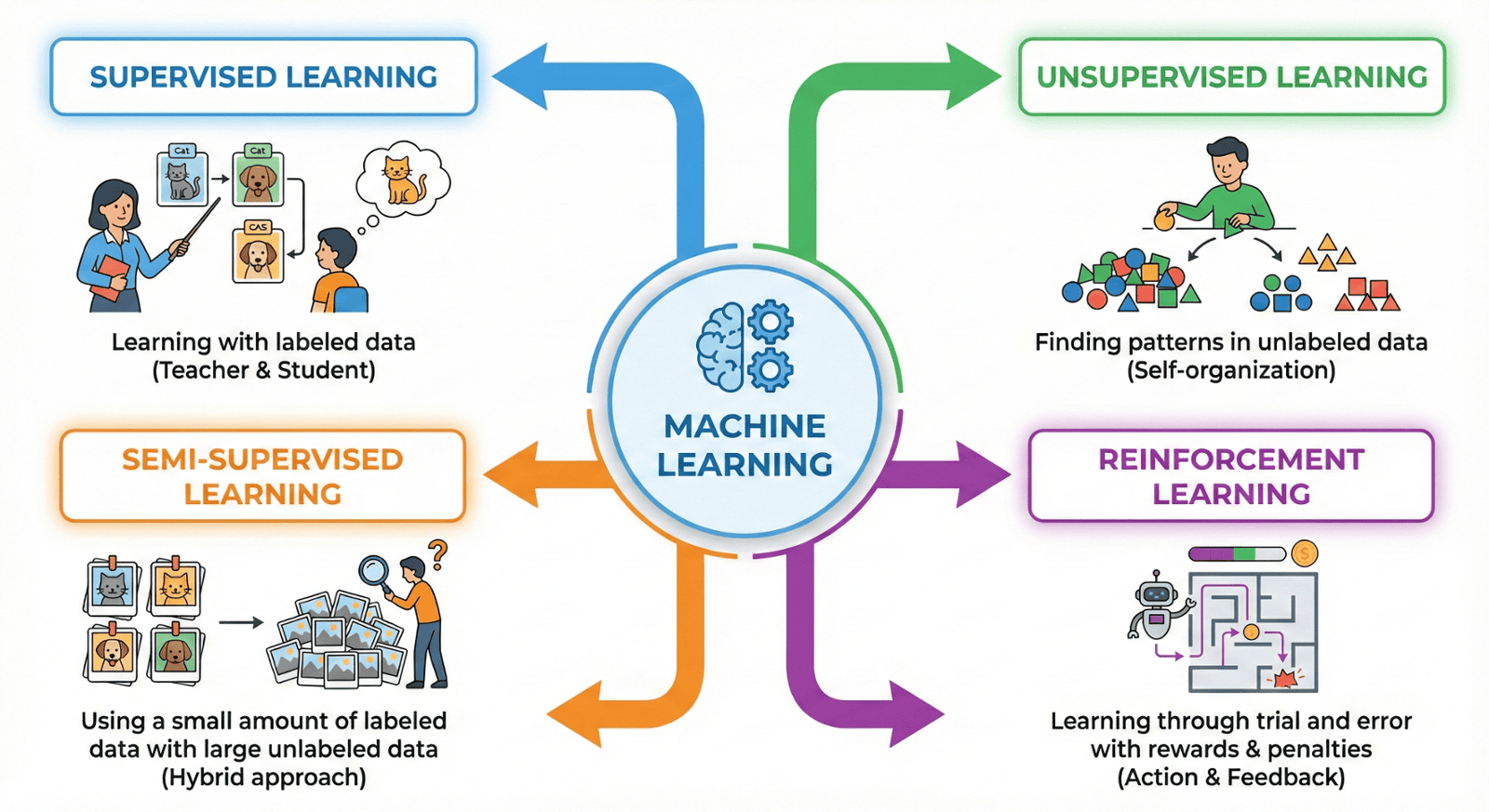
To make informed decisions about AI, business leaders should understand the basic learning approaches:
1. Supervised Learning
The AI is trained on labelled examples: "This email is spam," "This transaction is fraudulent," "This customer is likely to churn." It learns to recognise patterns that indicate each category.
Business Use Cases: Fraud detection, customer segmentation, demand forecasting, quality control
2. Unsupervised Learning
The AI finds patterns in unlabelled data without being told what to look for. It clusters similar items together or identifies anomalies.
Business Use Cases: Customer behaviour analysis, market segmentation, anomaly detection, recommendation systems
3. Reinforcement Learning
The AI learns through trial and error, receiving rewards for desired outcomes and penalties for poor ones. It develops strategies to maximise success over time.
Business Use Cases: Dynamic pricing, inventory optimisation, resource allocation, autonomous systems
4. Transfer Learning
The AI leverages knowledge gained from one task to improve performance on related tasks. This dramatically reduces the data and training time required.
Business Use Cases: Most modern AI tools use transfer learning, allowing businesses to benefit from models pre-trained on vast datasets without starting from scratch.
Key AI Technologies Business Leaders Should Know
Beyond the fundamental concept of AI, several specific technologies enable different business capabilities:
Natural Language Processing (NLP)
AI's ability to understand, interpret, and generate human language. This powers chatbots, sentiment analysis, document processing, and content generation.
Business Applications: Customer service automation, email analysis, contract review, content creation
Computer Vision
AI's ability to interpret and analyse visual information from images and video.
Business Applications: Quality control inspection, document digitisation, security monitoring, retail analytics
Predictive Analytics
AI systems that analyse historical data to forecast future outcomes with probabilistic accuracy.
Business Applications: Sales forecasting, customer churn prediction, equipment maintenance scheduling, risk assessment
Robotic Process Automation (RPA) Enhanced with AI
Traditional automation that follows rules, enhanced with AI's ability to handle variability and make decisions.
Business Applications: Invoice processing, data entry, report generation, compliance monitoring
Large Language Models (LLMs)
Advanced AI systems trained on vast text datasets that can understand context, generate human-quality text, and perform reasoning tasks.
Business Applications: Content generation, research assistance, code development, complex query handling
The AI Implementation Journey: What Business Leaders Need to Know
Phase 1: Education and Assessment (Where You Are Now)
Understanding AI fundamentals, identifying opportunities, and assessing organisational readiness.
Duration: 1-3 months
Investment: Low (primarily time and expert consultation)
Outcome: Clear understanding of where AI can deliver value
Phase 2: Strategic Planning
Developing a prioritised roadmap with specific use cases, business cases, and implementation plans.
Duration: 2-4 months
Investment: Medium (strategic consulting)
Outcome: Detailed AI strategy and vendor-agnostic technology recommendations
Phase 3: Pilot Implementation
Launching 1-3 small-scale AI projects to validate technology, measure impact, and build internal expertise.
Duration: 3-6 months
Investment: Medium to High (technology, integration, training)
Outcome: Proven AI capabilities with measurable ROI
Phase 4: Scaling and Optimisation
Expanding successful pilots across the organisation and optimising for maximum impact.
Duration: 6-18 months
Investment: High (broader deployment)
Outcome: AI integrated into core business operations
Critical Success Factor: Most AI initiatives fail not due to technology limitations, but because of poor strategic planning, unrealistic expectations, or inadequate change management. Expert guidance in Phases 1 and 2 prevents costly mistakes in Phases 3 and 4.
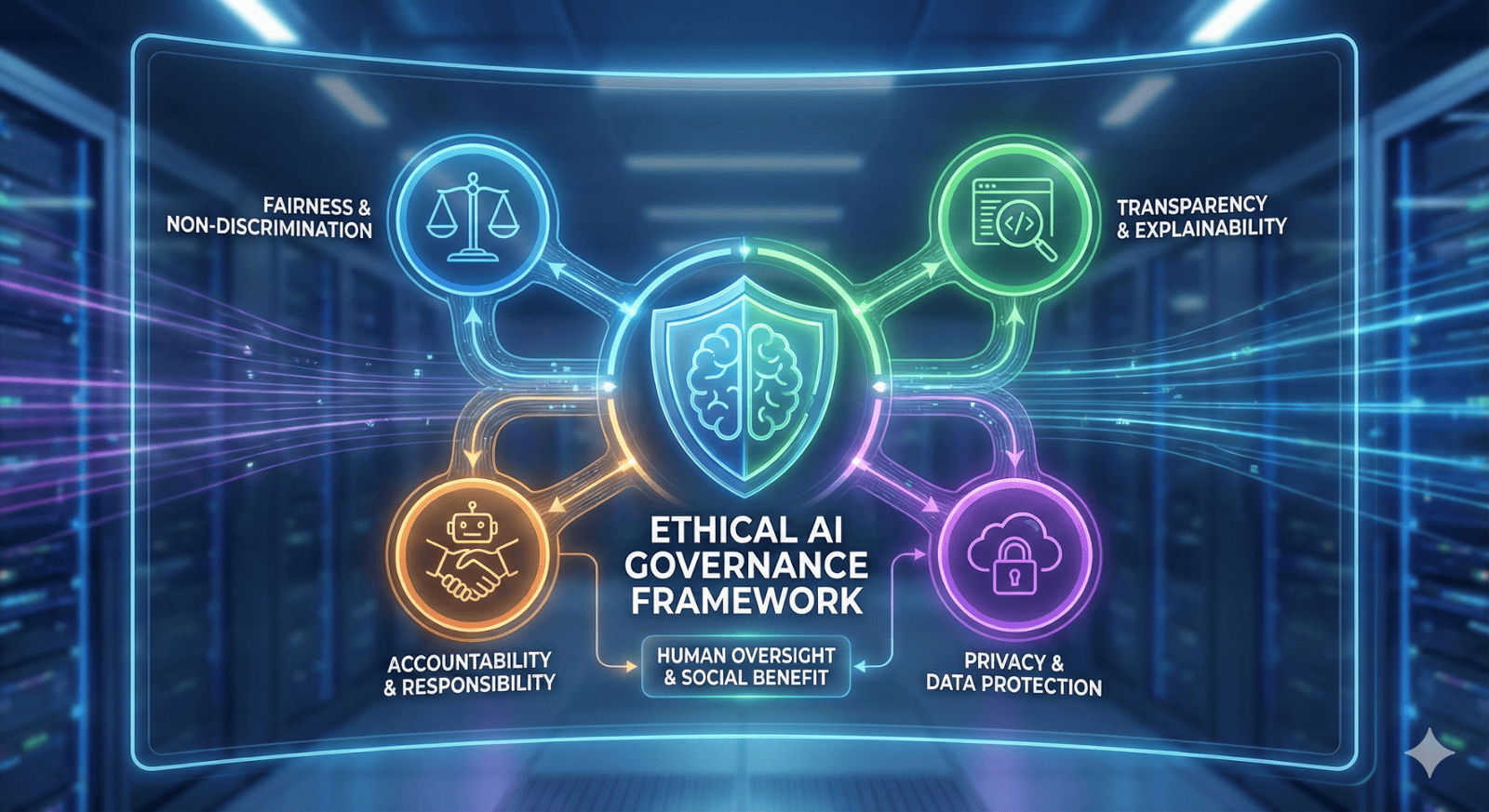
AI Ethics and Governance: Considerations for Responsible Implementation
As AI becomes integral to business operations, ethical considerations and governance frameworks become essential:
Key Ethical Considerations:
1. Bias and Fairness AI systems can perpetuate or amplify biases present in training data, leading to discriminatory outcomes in hiring, lending, or customer service.
Mitigation: Regular auditing, diverse training data, human oversight on consequential decisions
2. Transparency and Explainability Many AI systems operate as "black boxes," making decisions without clear explanations.
Mitigation: Choose interpretable AI models for high-stakes decisions, document AI decision-making processes
3. Privacy and Data Protection AI systems require access to data, raising concerns about customer privacy and regulatory compliance (GDPR, UK Data Protection Act).
Mitigation: Data minimisation, anonymisation, clear consent mechanisms, secure data handling
4. Accountability When AI makes mistakes, determining responsibility between developers, deployers, and users can be complex.
Mitigation: Clear governance frameworks, human-in-the-loop for critical decisions, incident response protocols
5. Job Displacement Concerns AI automation will change job roles, requiring workforce adaptation.
Mitigation: Transparent communication, reskilling programmes, focus on AI augmentation rather than replacement
Business leaders should establish AI governance policies before widespread implementation, not afterwards.
The Cost of AI: Understanding Investment Requirements
Business leaders frequently ask: "How much does AI cost?" The answer depends on your approach:
Low-Cost Entry Point (£500-£5,000/month)
- Using existing AI-powered SaaS tools (Microsoft Copilot, ChatGPT Enterprise, AI-enhanced CRM)
- Minimal customisation
- Quick deployment
- Best for: Testing AI capabilities, small teams, specific use cases
Mid-Range Implementation (£10,000-£100,000)
- Custom AI solutions for specific business processes
- Integration with existing systems
- Dedicated implementation support
- Best for: Medium-sized organisations, department-specific solutions
Enterprise AI Transformation (£100,000-£1,000,000+)
- Organisation-wide AI strategy and implementation
- Custom AI development
- Multiple integrated systems
- Dedicated AI infrastructure
- Best for: Large organisations, industry-leading AI capabilities
Critical Insight: The technology cost is often less than 40% of total AI investment. The majority of costs come from:
- Data preparation and cleaning
- System integration
- Change management and training
- Ongoing maintenance and optimisation
- Strategic planning and expert guidance
A £50,000 investment in expert strategic planning can prevent £500,000 in wasted technology spending.
Common AI Implementation Pitfalls (And How to Avoid Them)
1. Solution Looking for a Problem
Implementing AI because it's trendy, without clear business objectives.
Avoidance Strategy: Start with business problems, not technology. Ask: "What specific outcome would improve our business?" then determine if AI is the right solution.
2. Data Quality Neglect
Attempting AI implementation with insufficient, inaccurate, or poorly organised data.
Avoidance Strategy: Assess and clean your data infrastructure before AI implementation. "Garbage in, garbage out" applies doubly to AI.
3. Unrealistic Expectations
Expecting AI to deliver transformational results immediately without proper implementation and change management.
Avoidance Strategy: Set realistic timelines (6-18 months for meaningful impact), measure incremental improvements, and communicate progress transparently.
4. Vendor Lock-In
Committing to expensive, proprietary AI platforms without understanding alternatives or integration flexibility.
Avoidance Strategy: Work with vendor-agnostic advisors who prioritise your needs over sales commissions. Evaluate multiple options before commitment.
5. Ignoring Change Management
Deploying AI tools without adequate user training or addressing team concerns about automation.
Avoidance Strategy: Invest in communication, training, and demonstrating how AI enhances rather than replaces human work.
Ready to Move from Understanding to Action?
You now understand what AI is, how it works, and why it matters for your business. The next critical step is determining where and how AI can deliver value in your specific organisation.
This isn't something you should guess at. The difference between AI success and failure often comes down to strategic planning in these early stages.
The Consultancy World specialises in helping business leaders like you navigate this crucial phase.
What We Offer:
✓ AI Readiness & Opportunity Assessment
We analyse your operations to identify the highest-value, lowest-risk opportunities for AI integration.
✓ Custom AI Strategy & Roadmap
We deliver a detailed, practical plan that moves AI from concept to business asset—with clear priorities, timelines, and ROI projections.
✓ Vendor-Agnostic Technology Selection
We help you evaluate and select the right tools for your needs without sales pressure or commission bias.
✓ Implementation Support
We guide your team through pilot projects, ensuring successful deployment and measurable results.
Your Next Step: Book a Free 45-Minute Consultation
In this no-obligation session, we'll:
- Review your current business operations and strategic goals
- Identify 2-3 specific opportunities where AI could deliver immediate impact
- Discuss realistic timelines and investment requirements
- Answer all your questions about AI implementation
No sales pressure. No hidden costs. Just expert guidance from experienced AI strategists who are committed to your success, not software sales quotas.
Conclusion: AI Is a Strategic Imperative, Not Optional
Artificial Intelligence has evolved from experimental technology to essential business infrastructure. In 2025, the question is no longer "Should we adopt AI?" but "How do we implement AI strategically to drive measurable business value?"
The organisations that thrive in the next decade will be those that approach AI with clear strategy, realistic expectations, and expert guidance. They'll avoid the pitfalls that trap businesses who rush into AI without proper planning.
You've taken the first step by educating yourself on AI fundamentals. Now, take the next step toward strategic implementation.
Your competitors are already exploring AI. The time to develop your strategy is now.
About The Consultancy World
The Consultancy World is a vendor-agnostic AI strategy consultancy dedicated to helping businesses navigate the complex landscape of artificial intelligence. Unlike software vendors, we don't earn commissions or sell proprietary platforms. Our only objective is your success.
We provide strategic guidance, practical roadmaps, and implementation support that ensure your AI investments deliver measurable ROI. Our team combines deep technical expertise with business acumen, translating complex AI concepts into clear, actionable strategies.
Based in West Sussex, UK | Serving Clients Globally
Ready to discuss your AI strategy?
Further Reading from The Consultancy World Learning Library
Continue Your AI Education:
- Machine Learning vs AI vs Deep Learning: Understanding the Differences
- The Real Cost of AI Implementation: Beyond the Software Licence
- AI Terminology Demystified: 50 Essential Terms Every Leader Should Know
- How to Build an AI Strategy That Delivers ROI (Step-by-Step Framework)
This article was written by The Consultancy World's expert team and reflects current best practices in AI strategy as of December 2025. AI technologies and applications evolve rapidly. For the most current guidance specific to your business situation, please schedule a consultation with our team.
Last Updated: December 16, 2025
Reading Time: 18-22 minutes
Level: Beginner to Intermediate
Audience: Business Leaders, CEOs, Directors, Decision-Makers
© 2025 The Consultancy for Business Solutions Ltd. All rights reserved. E&OE