
Machine Learning vs AI vs Deep Learning: Understanding the Differences
Published by The Consultancy World | AI Strategy Experts | Last Updated: December 2025
Artificial Intelligence (AI), Machine Learning (ML), and Deep Learning (DL) are related but distinct concepts that are often confused in business discussions. Artificial Intelligence is the broadest concept—computer systems performing tasks requiring human-like intelligence. Machine Learning is a subset of AI where systems learn from data without explicit programming. Deep Learning is a specialized subset of Machine Learning using neural networks with multiple layers to process complex patterns. Understanding these distinctions enables business leaders to evaluate technology solutions accurately, communicate effectively with technical teams, and make informed investment decisions.
This guide clarifies the relationship between these terms and explains what each means for your business applications.
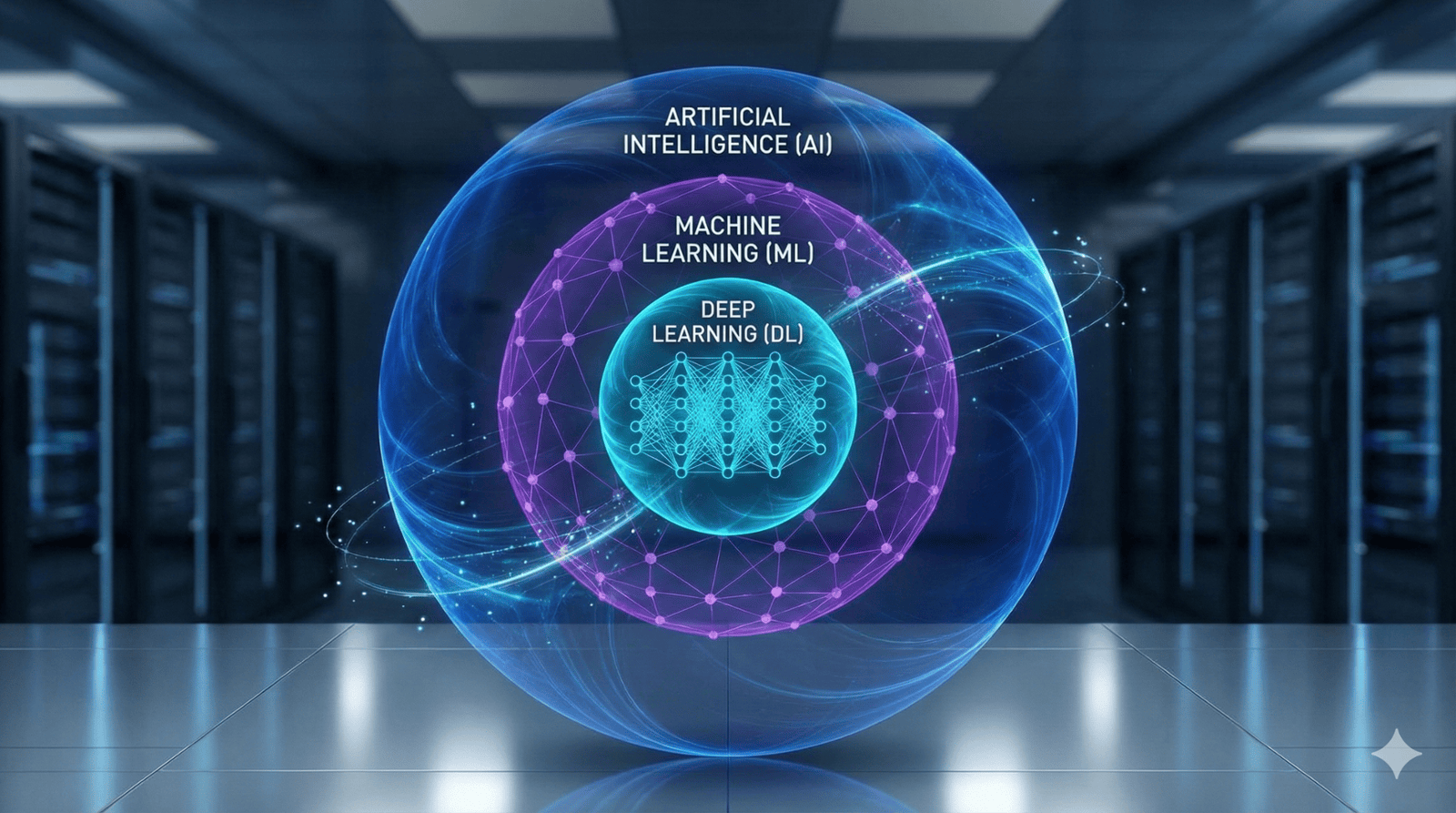
The Hierarchy: How These Concepts Relate
Think of these three concepts as nested Russian dolls:
Artificial Intelligence (Outermost Layer)
The broadest concept encompassing all systems that exhibit intelligent behaviour.
Machine Learning (Middle Layer)
A specific approach to achieving AI where systems learn patterns from data.
Deep Learning (Innermost Layer)
A specialised Machine Learning technique using complex neural networks.
All Deep Learning is Machine Learning. All Machine Learning is AI. But not all AI uses Machine Learning, and not all Machine Learning uses Deep Learning.
Artificial Intelligence: The Complete Picture
Definition
Artificial Intelligence refers to any computer system designed to perform tasks that typically require human intelligence - reasoning, learning, perception, language understanding, or problem-solving.
The Two Categories of AI
1. Rule-Based AI (Traditional AI)
Systems programmed with explicit rules and logic:
• Expert systems following "if-then" decision trees
• Chess programs evaluating moves using predefined strategies
• Basic chatbots responding to specific keywords
• Traditional automation following set procedures
Business Example: A customer service system that routes enquiries based on keywords: if the message contains "refund," send to billing department; if it contains "delivery," send to logistics.
2. Machine Learning AI (Modern AI)
Systems that learn patterns from data rather than following pre-programmed rules. This is where Machine Learning enters the picture.
Business Example: A customer service system that learns which enquiries should go to which department by analysing thousands of past enquiries and their successful resolutions.
Key Distinction: Traditional AI requires human experts to codify knowledge into rules. Machine Learning AI discovers patterns automatically from data.
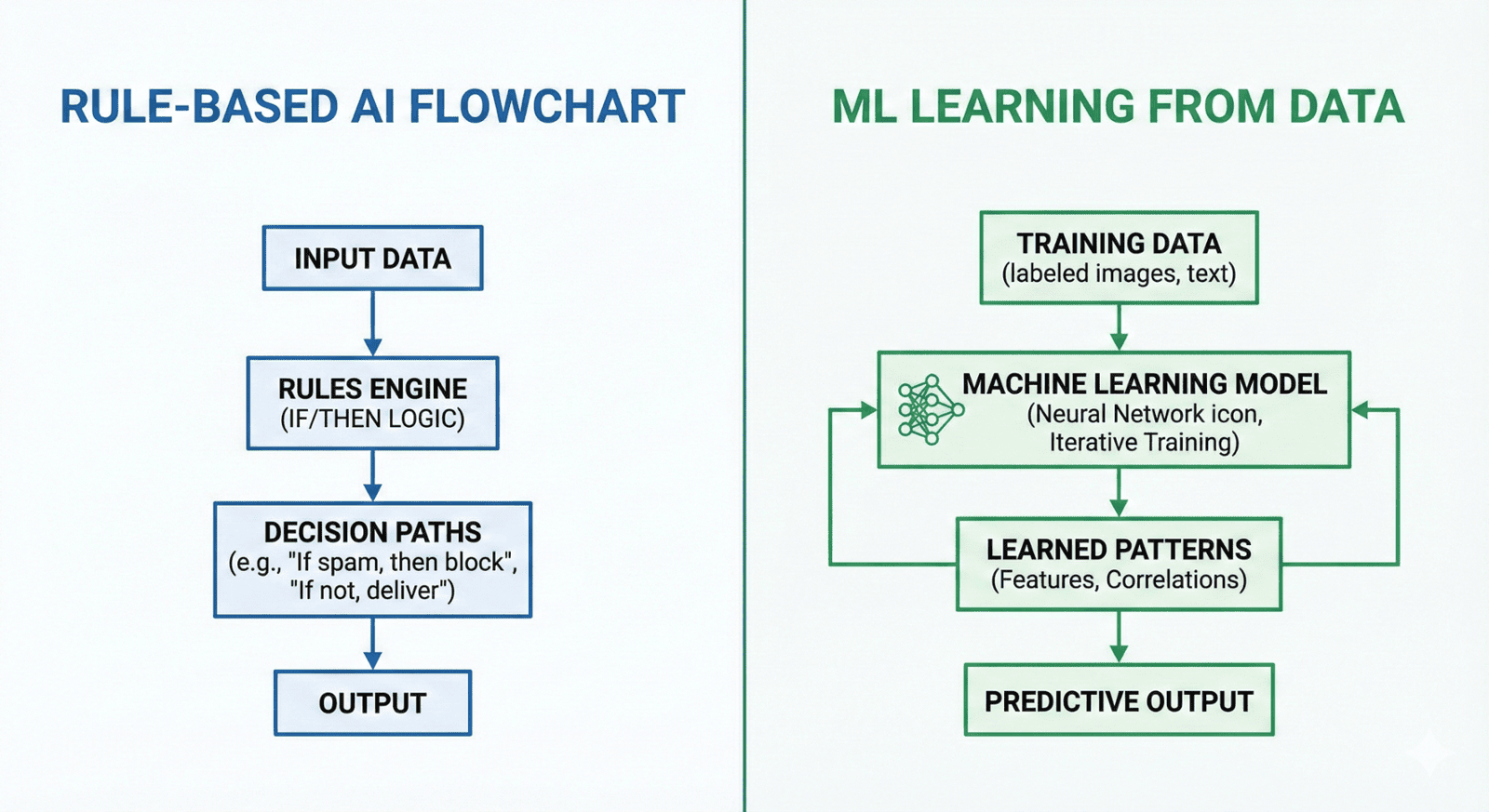
Machine Learning: How Systems Learn from Experience
What Is Machine Learning?
Machine Learning is an approach to AI where systems improve their performance on specific tasks by learning from data and experience, rather than being explicitly programmed with rules for every scenario.
The Core Principle
Instead of telling a computer exactly how to perform a task, you provide examples of inputs and desired outputs. The Machine Learning system identifies patterns connecting inputs to outputs and applies those patterns to new, unseen data.
Real-World Business Analogy
Traditional Programming:
"When a customer's order value exceeds £500 and they've made 5+ previous purchases and their account is over 12 months old, offer them a 10% loyalty discount."
Machine Learning:
Show the system data on thousands of customers—their purchase history, order values, account age, and whether offering a discount increased their lifetime value. The ML system discovers which combinations of factors indicate a discount will be profitable, potentially finding patterns humans never explicitly programmed.
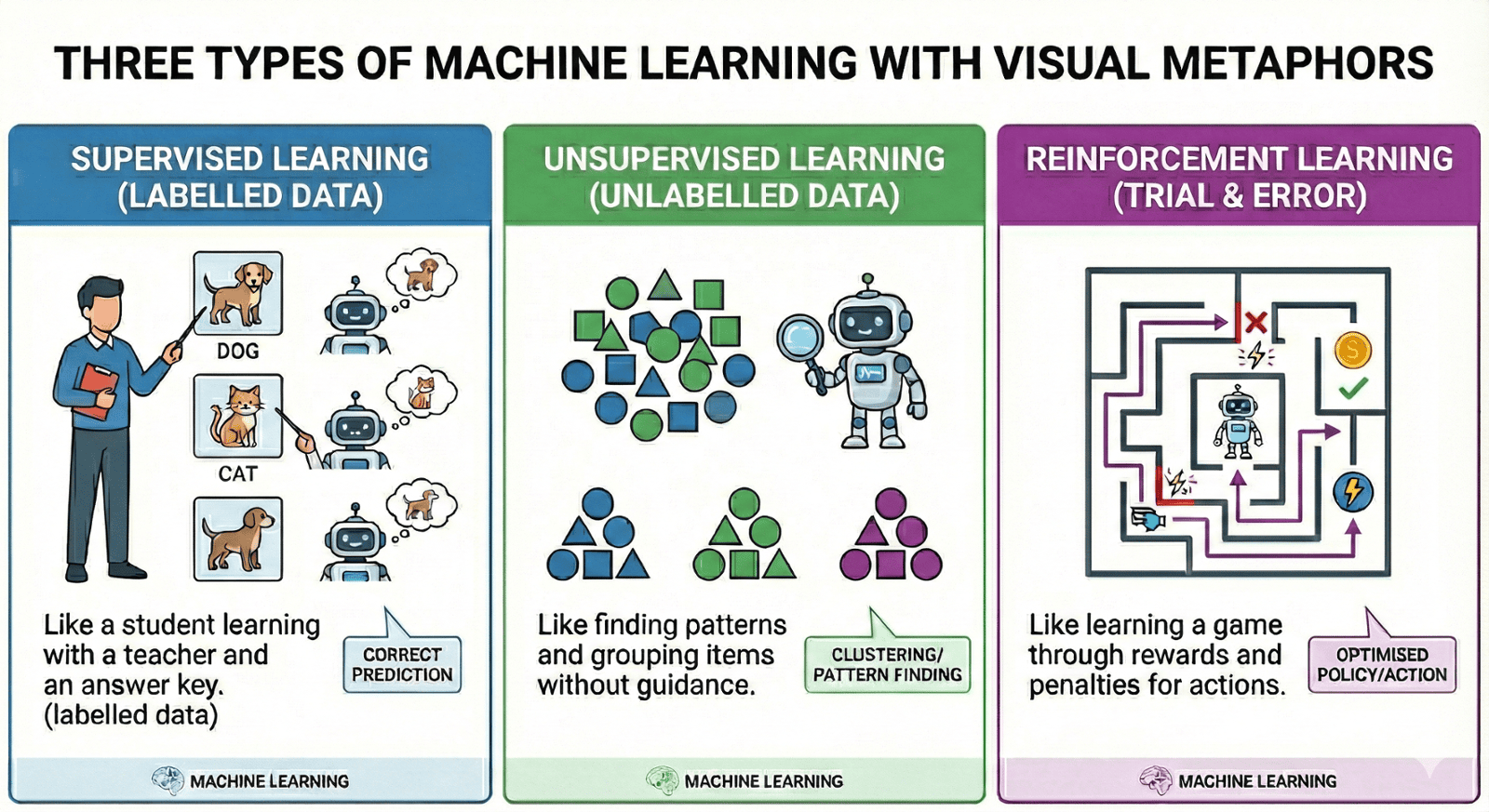
The Three Types of Machine Learning
1. Supervised Learning
The system learns from labelled training data - examples where the correct answer is provided.
How It Works:
• Show the system thousands of emails labelled "spam" or "not spam"
• The system learns patterns that distinguish spam from legitimate messages
• When new emails arrive, it predicts which category they belong to
Business Applications:
• Customer churn prediction (which customers are likely to leave?)
• Fraud detection (is this transaction fraudulent?)
• Sales forecasting (what will revenue be next quarter?)
• Credit risk assessment (should we approve this loan?)
• Quality control (is this product defective?)
Requirements:
• Large amounts of accurately labelled training data
• Clear definition of what constitutes the "correct" answer
• Ongoing validation to ensure accuracy
2. Unsupervised Learning
The system finds patterns in unlabelled data without being told what to look for.
How It Works:
• Provide customer data without any labels or categories
• The system identifies natural groupings—customers with similar behaviours
• You then interpret what these groups represent
Business Applications:
• Customer segmentation (discovering natural customer types)
• Anomaly detection (identifying unusual patterns that might indicate problems)
• Market basket analysis (which products are purchased together?)
• Document clustering (organizing large document collections)
Key Advantage: Discovers patterns humans might not think to look for.
3. Reinforcement Learning
The system learns through trial and error, receiving rewards for desired outcomes.
How It Works:
• The system tries different actions in an environment
• It receives positive feedback (rewards) for successful actions
• It receives negative feedback (penalties) for poor actions
• Over time, it learns strategies that maximize rewards
Business Applications:
• Dynamic pricing optimization (testing different price points)
• Resource allocation (optimizing staff schedules or inventory placement)
• Trading strategies (learning profitable market behaviours)
• Supply chain optimisation (balancing cost, speed, and reliability)
Key Characteristic: Learns optimal strategies in complex, changing environments.
Deep Learning: The Power of Neural Networks
What Is Deep Learning?
Deep Learning is a specialised subset of Machine Learning that uses artificial neural networks with multiple layers (hence "deep") to process information in increasingly abstract ways, similar to how human brains process information hierarchically.
Why "Deep"?
The "deep" refers to the number of layers in the neural network. While traditional Machine Learning might use a single-layer model, Deep Learning uses networks with dozens or hundreds of layers, each extracting progressively more complex features from the data.
The Visual Recognition Example
When a Deep Learning system identifies a cat in a photo:
Layer 1 (Early Processing):
Detects basic patterns—edges, corners, simple shapes
Layer 2-3 (Mid-Level Processing):
Combines edges into features—curves, textures, colour patterns
Layer 4-6 (High-Level Processing):
Recognises complex features - ears, whiskers, fur patterns
Final Layers:
Combines all features to conclude: "This is a cat"
Each layer builds upon the previous one, creating increasingly sophisticated representations of the input data.
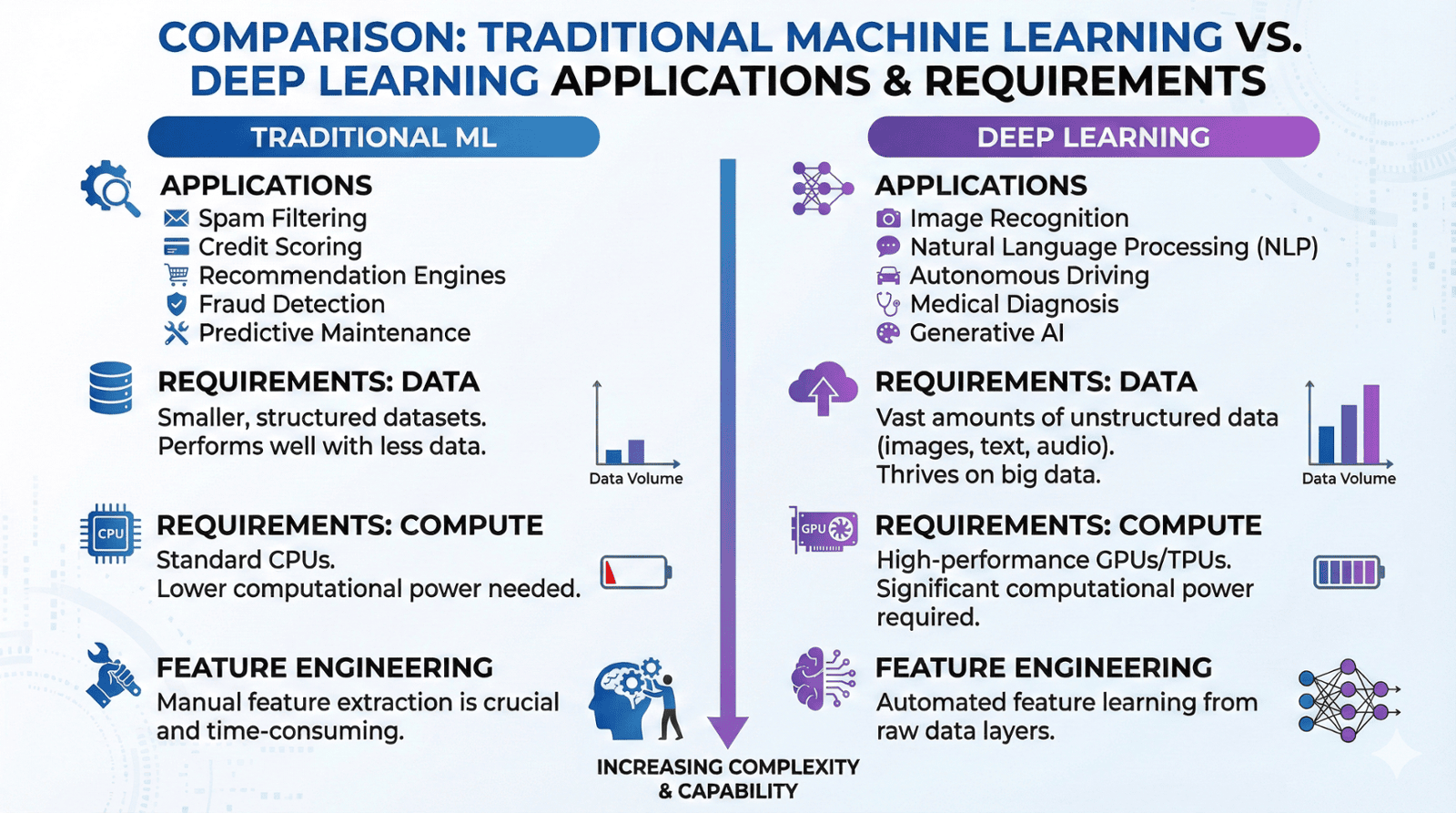
Deep Learning vs Traditional Machine Learning: When to Use Which
Traditional Machine Learning Strengths:
• Works with smaller datasets (thousands of examples rather than millions)
• Faster to train and deploy
• More interpretable—easier to understand why decisions were made
• Less computationally expensive
• Better for structured data (spreadsheets, databases)
Best For:
• Predicting customer churn with historical transaction data
• Classifying support tickets
• Forecasting sales based on historical patterns
• Credit scoring
Deep Learning Strengths:
• Excels with massive datasets (millions of examples)
• Automatically discovers complex features without manual feature engineering
• Superior performance on unstructured data (images, audio, video, text)
• Handles high complexity in patterns and relationships
Best For:
• Image recognition and analysis
• Natural language understanding (chatbots, sentiment analysis)
• Speech recognition
• Video processing
• Complex pattern recognition in large datasets
Confused About Which AI Approach Fits Your Business Needs?
Understanding the differences between AI, Machine Learning and Deep Learning is just the first step. The critical question is: Which approach will deliver the most value for YOUR specific business challenges?
This isn't a decision to make based on buzzwords or vendor marketing. It requires careful analysis of your:
• Data availability and quality
• Specific business objectives
• Budget and resource constraints
• Timeline expectations
• Technical infrastructure
The Consultancy World specialises in cutting through the confusion.
In a complimentary 45-minute consultation, we'll:
✓ Review your specific business challenges and goals
✓ Assess which AI/ML approach is most appropriate
✓ Identify data requirements and feasibility
✓ Provide realistic cost and timeline expectations
✓ Recommend specific next steps tailored to your situation
[Book Your Free AI Technology Assessment →](https://www.theconsultancy.world/book-call)
No technical jargon. No sales pressure. Just clear, actionable guidance.
Practical Business Examples: AI vs ML vs DL in Action
Scenario 1: Customer Service Automation
Rule-Based AI Approach:
Create decision tree: If message contains "return", route to returns team. If contains "technical", route to technical support.
Limitations: Fails with variations ("I want to send this back", "not working properly")
Machine Learning Approach:
Train system on thousands of customer messages and their correct routing destinations. System learns language patterns indicating intent.
Advantage: Handles variations, slang, and complex queries accurately.
Deep Learning Approach:
Use advanced natural language models that understand context, sentiment, and nuance. Can generate appropriate responses, not just route messages.
Advantage: Provides fully automated, contextually appropriate responses to most enquiries.
Business Decision: Deep Learning offers the most sophisticated solution but requires significant data and resources. Most businesses start with Machine Learning for routing, then evolve to Deep Learning for response generation.
Scenario 2: Fraud Detection in Financial Services
Traditional AI Approach:
Hard-coded rules: Flag transactions over £10,000, flag purchases in foreign countries, flag multiple transactions in short timeframe.
Limitation: Fraudsters learn the rules and work around them.
Machine Learning Approach:
Analyse patterns in millions of historical transactions (both fraudulent and legitimate). System learns subtle indicators of fraud that rules-based systems miss.
Advantage: Adapts to evolving fraud patterns, catches sophisticated schemes.
Deep Learning Approach:
Process multiple data sources simultaneously (transaction patterns, device fingerprints, typing patterns, location data) to detect complex fraud schemes.
Advantage: Superior accuracy with lower false positive rates, particularly for sophisticated fraud.
Business Decision: Most financial institutions use Machine Learning as a foundation, adding Deep Learning for complex fraud detection on high-value transactions.
Scenario 3: Inventory Forecasting for Retail
Traditional Approach:
Basic statistical models based on historical sales averages and seasonal trends.
Machine Learning Approach:
Analyse multiple factors simultaneously: sales history, weather patterns, local events, economic indicators, competitor pricing, social media trends.
Advantage: 15-25% improvement in forecast accuracy compared to traditional statistical methods.
Deep Learning Approach:
Process unstructured data sources (social media sentiment, news articles, fashion trends) alongside structured sales data for highly nuanced predictions.
Advantage: Best performance for complex, fast-changing markets.
Business Decision: Machine Learning delivers strong ROI for most retailers. Deep Learning makes sense for high-margin, fashion-forward products where trends matter significantly.
The Data Question: How Much Do You Need?
A critical distinction between these approaches is data requirements:
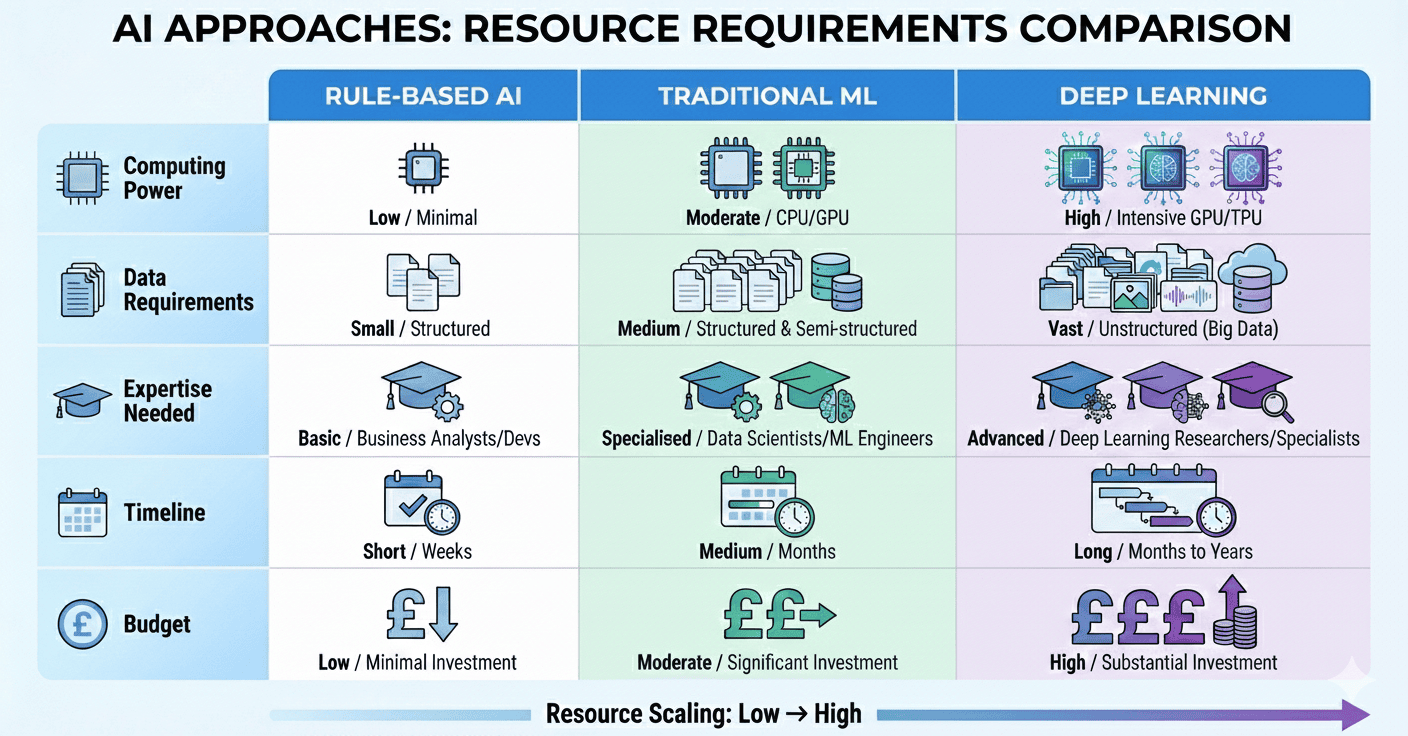
Rule-Based AI
Data Required: Minimal - just expert knowledge to create rules
Example: 50-100 examples to understand common scenarios
Development Time: Fast (days to weeks)
Traditional Machine Learning
Data Required: Moderate - thousands to tens of thousands of examples
Example: 5,000-50,000 labelled examples for supervised learning
Development Time: Moderate (weeks to months)
Deep Learning
Data Required: Extensive - hundreds of thousands to millions of examples
Example: 100,000+ images to train a custom image recognition system
Development Time: Longer (months)
Critical Business Insight: More sophisticated isn't always better. If you have 2,000 customer service tickets, Machine Learning will outperform Deep Learning. The best approach matches your data reality, not buzzword appeal.
Common Misconceptions Business Leaders Should Know
Misconception 1: "We need Deep Learning for AI"
Reality: Most business problems are solved effectively with traditional Machine Learning or even rule-based systems enhanced with basic ML. Deep Learning is powerful but often unnecessary and more expensive than simpler solutions.
Misconception 2: "AI systems understand like humans do"
Reality: AI, ML, and DL systems recognise patterns through mathematical optimisation. They don't "understand" in the human sense - they find statistical correlations in data.
Misconception 3: "Once trained, the system works forever"
Reality: All ML and DL systems require ongoing monitoring and retraining as patterns in real-world data change over time (known as "model drift").
Misconception 4: "Deep Learning always outperforms traditional ML"
Reality: With limited data or simple problems, traditional ML often delivers better results faster and more cost-effectively than Deep Learning.
Misconception 5: "AI/ML eliminates the need for human expertise"
Reality: Subject matter expertise remains crucial for defining problems correctly, preparing quality data, interpreting results and making final decisions.
Computing Power and Infrastructure Requirements
Rule-Based AI
Infrastructure: Standard business servers, can run on basic hardware
Cloud Costs: Minimal (£50-500/month)
Expertise Required: Business analysts, software developers
Traditional Machine Learning
Infrastructure: Moderate computing power, cloud-based solutions widely available
Cloud Costs: Low to moderate (£500-5,000/month for typical business applications)
Expertise Required: Data scientists or ML engineers (can be outsourced)
Deep Learning
Infrastructure: Significant computing power, typically requires GPUs or specialised AI processors
Cloud Costs: Moderate to high (£2,000-50,000+/month depending on scale)
Expertise Required: Specialised deep learning engineers, data engineering teams
The Democratisation Factor: Pre-trained Deep Learning models (like ChatGPT, Claude, Google's Vision API) allow businesses to leverage Deep Learning capabilities without building systems from scratch - dramatically reducing costs and expertise requirements.
Which Approach Should Your Business Choose?
The right choice depends on your specific situation:
Choose Rule-Based AI When:
• You have limited data
• Problems follow clear, definable rules
• Interpretability is crucial (e.g., regulatory requirements)
• You need quick deployment
• Budget is constrained
Examples: Basic customer routing, simple recommendation systems, compliance checks
Choose Traditional Machine Learning When:
• You have thousands of labelled examples
• Patterns exist but are too complex for simple rules
• You need good performance without massive data requirements
• Budget allows for moderate investment
• Structured data is primary input (spreadsheets, databases)
Examples: Customer churn prediction, sales forecasting, fraud detection, demand planning
Choose Deep Learning When:
• You have massive datasets (hundreds of thousands of examples)
• Working with unstructured data (images, video, complex text)
• Problem complexity requires sophisticated pattern recognition
• You need state-of-the-art performance
• Budget supports significant investment
Examples: Advanced natural language understanding, image recognition, video analysis, complex speech processing
Choose Pre-Trained Deep Learning (Most Common) When:
• You want Deep Learning capabilities without building from scratch
• Using established use cases (chatbots, image recognition, text analysis)
• Limited internal AI expertise
• Need quick time-to-value
Examples: ChatGPT for content generation, Google Cloud Vision for image analysis, Azure Cognitive Services for various AI tasks
The Evolution Path: How Businesses Typically Progress
Most successful AI implementations follow a maturity progression:
Stage 1: Rule-Based Automation (Months 1-6)
Start with simple automation of clear, rule-based processes. Low risk, quick wins, builds organisational confidence.
ROI: 10-30% efficiency improvements in targeted processes
Stage 2: Traditional ML Implementation (Months 6-18)
Deploy ML models for prediction and classification tasks using historical data. Moderate complexity, measurable business impact.
ROI: 20-40% improvements in forecast accuracy, customer targeting, operational efficiency
Stage 3: Advanced ML at Scale (Months 18-36)
Expand ML across multiple business functions, integrate with core systems, develop organisational ML capability.
ROI: 15-25% improvement in overall operational metrics
Stage 4: Deep Learning for Complex Problems (Months 36+)
Implement DL solutions for unstructured data, complex pattern recognition, or when traditional ML reaches performance limits.
ROI: Varies significantly by application; typically justified by competitive advantage rather than immediate efficiency gains
Critical Success Factor: Organisations that skip stages and jump to Deep Learning without foundational capabilities experience significantly higher failure rates and wasted investment.
Ready to Determine the Right AI Approach for Your Business?
You now understand the distinctions between AI, Machine Learning, and Deep Learning. The next crucial step is mapping these capabilities to your specific business challenges and determining the optimal path forward.
This is precisely where most businesses need expert guidance.
Without proper assessment, you might:
• Invest in Deep Learning when simpler ML would deliver better ROI
• Choose ML when rule-based systems would solve the problem faster
• Miss opportunities where pre-trained models could deliver immediate value
• Waste months on approaches that don't match your data reality
The Consultancy World Advantage
We are 100% vendor-agnostic AI strategists. We don't sell software or earn commissions. Our sole objective is helping you select the right approach for maximum business impact.
Our Strategic Assessment Includes:
✓ Data Evaluation: Assessing whether your current data supports ML/DL approaches
✓ Use Case Matching: Identifying which AI approach best suits each business problem
✓ Cost-Benefit Analysis: Calculating realistic ROI for different technology options
✓ Roadmap Development: Creating a phased implementation plan that builds on successes
✓ Vendor Recommendations: Suggesting specific tools and platforms aligned with your strategy
Conclusion: Clarity Enables Better Decisions
Understanding the differences between Artificial Intelligence, Machine Learning, and Deep Learning isn't just semantic—it's strategically essential. These distinctions enable you to:
• Evaluate vendor claims critically (Is that really "AI" or just rule-based automation?)
• Make informed budget decisions (Do we really need Deep Learning, or will ML deliver better ROI?)
• Communicate effectively with technical teams (Speak the same language as data scientists)
• Plan realistic timelines (Deep Learning projects take longer than traditional ML)
• Assess your data readiness (Do we have enough data for the approach we're considering?)
The most successful AI implementations match technology sophistication to business requirements—not the other way around.
Your next step is determining which approach delivers maximum value for your specific business challenges. That's where expert strategic guidance makes the difference between AI success and expensive lessons learned the hard way.
About The Consultancy World
The Consultancy World provides vendor-agnostic AI strategy consulting for businesses navigating the complex landscape of artificial intelligence. We translate technical complexity into clear business strategy, helping you select the right approaches, avoid costly mistakes, and achieve measurable ROI.
Unlike software vendors, we don't earn commissions or sell platforms. Our recommendations are based purely on what delivers the best outcomes for your specific situation.
Based in West Sussex, UK | Serving Clients Globally
Questions about which AI approach suits your business?
Contact us https://www.theconsultancy.world/contact or schedule a free consultation https://www.theconsultancy.world/book-call
Further Reading from The Consultancy World Learning Library
Continue Your AI Education:
• What Is Artificial Intelligence? A Business Leader's Guide
• Generative AI Explained: How ChatGPT and Similar Tools Actually Work
• How AI Actually Learns: Training Data, Models and Algorithms Simplified
• The Real Cost of AI Implementation: Beyond the Software Licence
This article was written by The Consultancy World's expert team and reflects current best practices in AI strategy as of December 2025.
Last Updated: December 18, 2025
Reading Time: 16-20 minutes
Level: Beginner to Intermediate
Audience: Business Leaders, Technology Decision-Makers
© 2025 The Consultancy for Business Solutions Ltd. All rights reserved. E&OE