The Real Cost of AI Implementation: Beyond the Software Licence
Published by The Consultancy World | AI Strategy Experts | Last Updated: December 2025
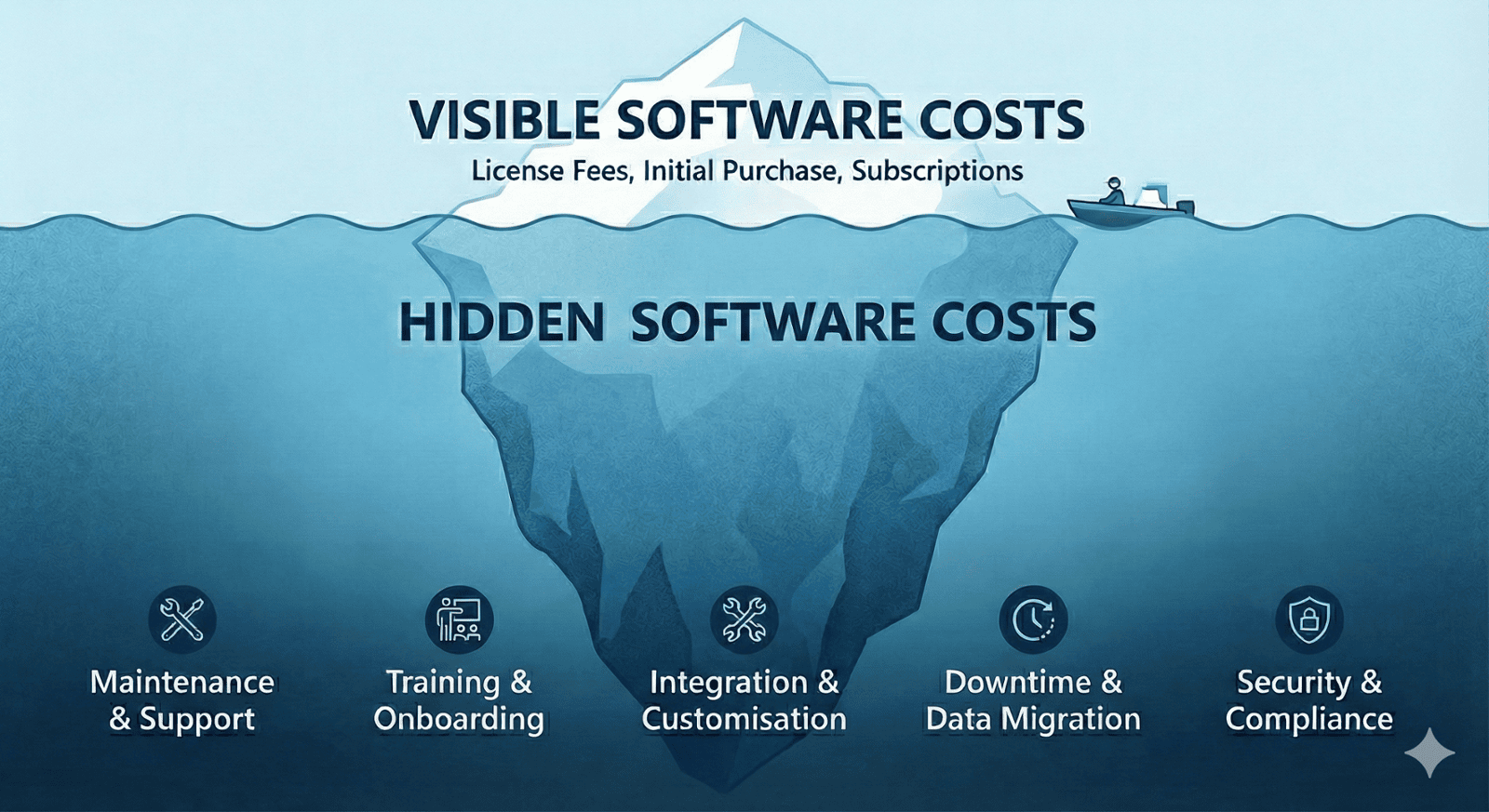
The true cost of implementing AI in business extends far beyond software licensing fees. Whilst vendors promote monthly subscription costs - £20 per user for ChatGPT Enterprise, £50,000 for enterprise AI platforms - the complete investment includes data preparation, system integration, change management, training, ongoing maintenance and strategic planning.
Research from Gartner indicates that software costs typically represent only 20-35% of total AI implementation expenses. The remaining 65-80% comprises hidden costs that organisations frequently underestimate, leading to budget overruns and failed projects.
For business leaders planning AI initiatives, understanding the full cost structure is essential for accurate budgeting, realistic ROI projections, and securing appropriate resources. This guide provides a comprehensive breakdown of AI implementation costs, helping you avoid the most common financial pitfalls.
The Complete Cost Structure of AI Implementation
AI implementation costs fall into seven primary categories:
1. Strategic Planning and Assessment (10-15% of total cost)
2. Software and Technology Licensing (20-35% of total cost)
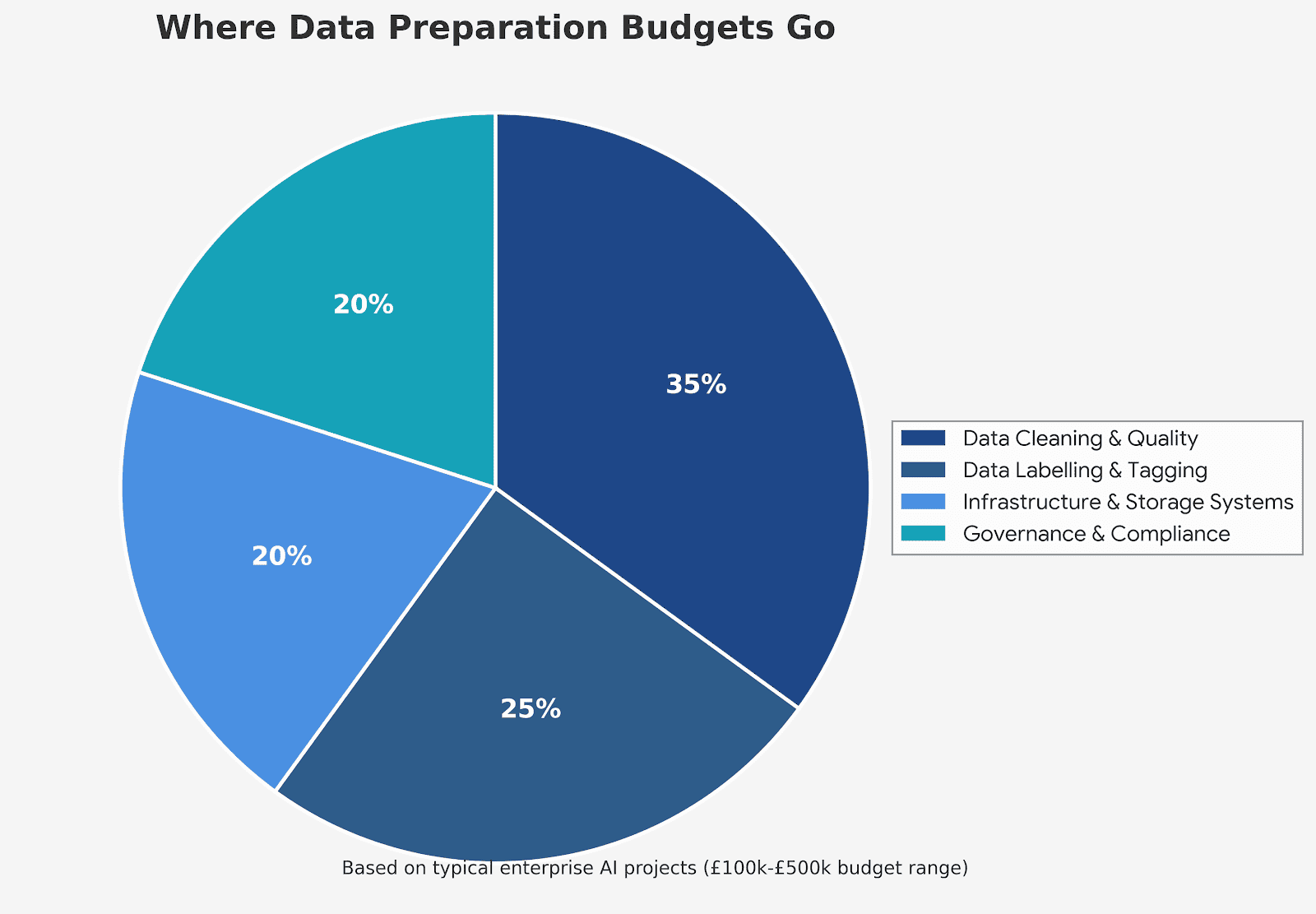
3. Data Preparation and Infrastructure (20-30% of total cost)
4. Integration and Development (15-25% of total cost)
5. Change Management and Training (10-15% of total cost)
6. Ongoing Operations and Maintenance (15-20% annual cost)
7. Risk Management and Governance (5-10% of total cost)
Critical Insight: Organisations that allocate 80% of budget to technology and 20% to everything else typically fail. Successful implementations reverse this ratio.
Category 1: Strategic Planning and Assessment
What It Includes:
• AI readiness assessment
• Opportunity identification and prioritisation
• Business case development
• Technology evaluation and vendor selection
• Implementation roadmap creation
• Stakeholder alignment workshops
Why It Matters:
Strategic planning prevents costly mistakes. A £25,000 investment in expert guidance can prevent £250,000 in wasted technology spending.
Typical Costs:
Small Business (£1M-£10M revenue):
• Internal assessment: £5,000-£15,000 (staff time)
• External consultant: £10,000-£30,000
• Total: £15,000-£45,000
Medium Business (£10M-£100M revenue):
• Internal assessment: £15,000-£40,000
• External consultant: £30,000-£75,000
• Total: £45,000-£115,000
Enterprise (£100M+ revenue):
• Internal assessment: £50,000-£150,000
• External consultant: £75,000-£250,000
• Total: £125,000-£400,000
Common Mistake: Skipping this phase and jumping straight to technology selection. This typically leads to:
• Wrong technology choices for actual needs
• Unclear ROI and business objectives
• Low adoption rates
• Failed pilot projects
ROI Impact: Proper planning typically delivers 3-5x return through avoided mistakes and optimised implementation.
Category 2: Software and Technology Licensing
What It Includes:
• AI platform subscriptions
• API usage fees
• Development tools and frameworks
• Third-party integrations
• Enterprise features and support
Licensing Models:
Per-User Licensing
Best For: Tools used by specific teams
Examples:
• ChatGPT Enterprise: £48/user/month
• Microsoft Copilot: £24/user/month
• Salesforce Einstein: £50-£150/user/month
Total Cost Calculation:
50 users × £40/month × 12 months = £24,000/year
Hidden Cost: Users often need multiple tools - AI assistant + specialised tool + integrations
API/Usage-Based Pricing
Best For: Custom applications, high-volume automated tasks
Examples:
• OpenAI API: £0.01-£0.12 per 1,000 tokens
• Google Cloud AI: £0.50-£8.00 per 1,000 predictions
• AWS AI services: Variable by service
Total Cost Calculation:
Complex and usage-dependent. A chatbot handling 10,000 interactions monthly might cost £500-£2,000/month in API fees alone.
Hidden Cost: Usage can spike unexpectedly, especially during testing phases or viral adoption.
Platform Licensing
Best For: Enterprise-wide AI capabilities
Examples:
• Custom AI platforms: £50,000-£500,000/year
• Industry-specific AI solutions: £100,000-£1,000,000/year
• Enterprise resource planning (ERP) AI modules: £25,000-£250,000/year
Total Cost Calculation:
Base platform + modules + users + support = highly variable
Hidden Cost: Long-term contracts lock you in, even if technology becomes outdated.
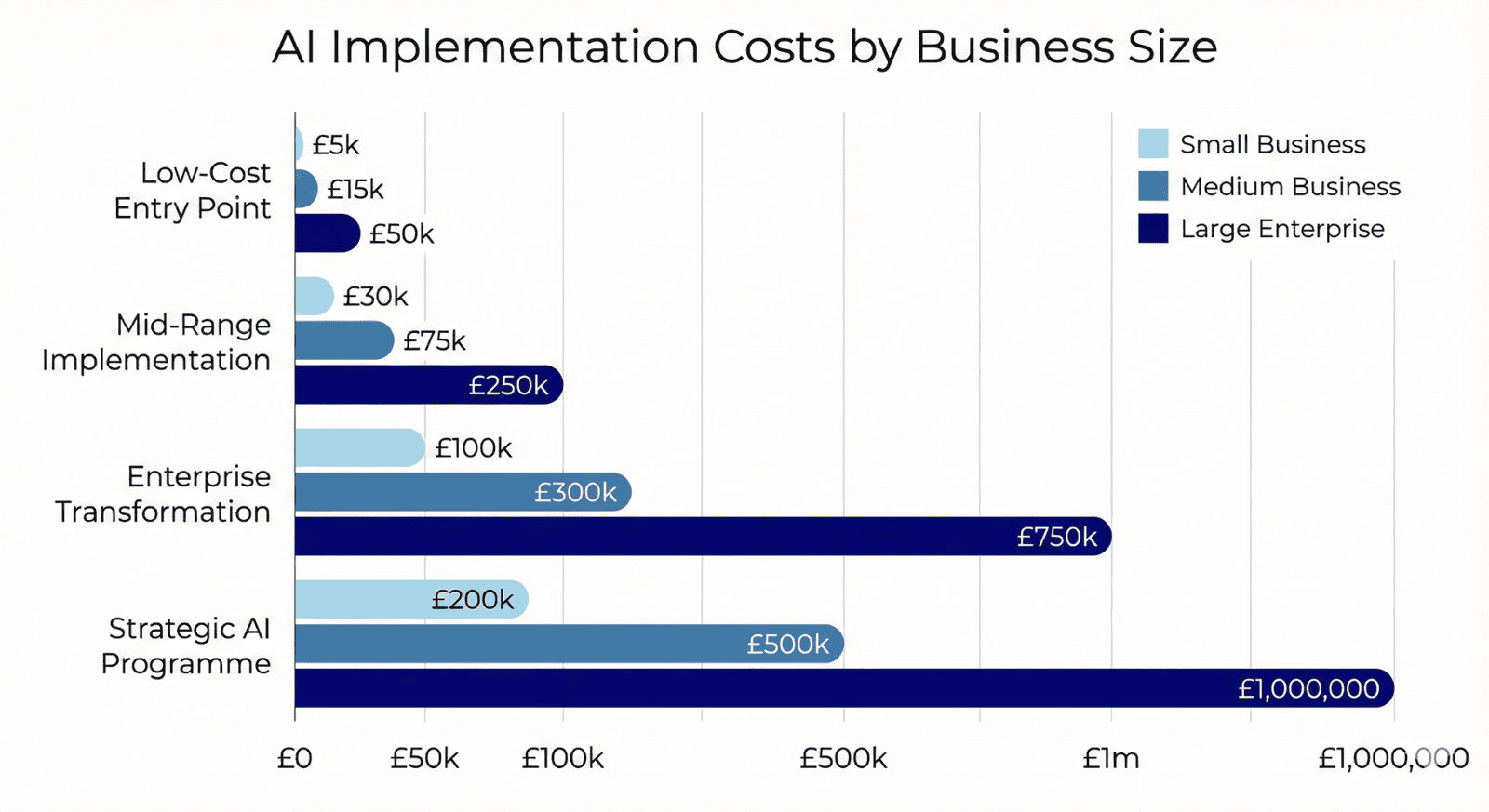
Typical Annual Software Costs:
Small Business Implementation:
£10,000-£50,000/year
• 2-3 AI tools for specific functions
• API access for custom applications
• Basic support tiers
Medium Business Implementation:
£50,000-£250,000/year
• Multiple departmental AI tools
• Custom development platforms
• Enhanced support and SLAs
Enterprise Implementation:
£250,000-£2,000,000+/year
• Organisation-wide AI platforms
• Custom and commercial solutions
• Premium support and dedicated account management
Category 3: Data Preparation and Infrastructure
What It Includes:
• Data cleaning and quality improvement
• Data labelling and annotation
• Database restructuring
• Storage infrastructure
• Computing resources (GPUs, cloud computing)
• Data governance implementation
Why It's Expensive:
AI requires high-quality, well-organised data. Most businesses discover their data is messy, incomplete, inconsistent, or poorly structured.
Data Preparation Costs:
Data Cleaning:
• Automated cleaning tools: £5,000-£25,000
• Manual cleaning (staff time): £20,000-£200,000
• Data quality assessment: £10,000-£50,000
Data Labelling:
For supervised machine learning projects requiring labelled training data:
• Internal labelling: £25-£75/hour (staff time)
• External labelling services: £15-£45/hour
• Automated labelling tools: £10,000-£100,000
Example: Labelling 50,000 images at £0.50 per image = £25,000
Infrastructure Costs:
Cloud Computing (typical for most businesses):
• Small projects: £500-£2,000/month (£6,000-£24,000/year)
• Medium projects: £2,000-£10,000/month (£24,000-£120,000/year)
• Large projects: £10,000-£50,000+/month (£120,000-£600,000+/year)
On-Premise Infrastructure (for large enterprises):
• GPU servers: £15,000-£75,000 per server
• Storage systems: £25,000-£250,000
• Networking upgrades: £10,000-£100,000
• Maintenance: 15-20% of hardware cost annually
Typical Data & Infrastructure Costs:
Small Business: £25,000-£100,000 (one-time) + £10,000-£50,000/year (ongoing)
Medium Business: £100,000-£500,000 (one-time) + £50,000-£250,000/year (ongoing)
Enterprise: £500,000-£5,000,000+ (one-time) + £250,000-£2,000,000+/year (ongoing)
Common Mistake: Underestimating data quality issues. Organisations often discover data problems only after commencing AI projects.
Category 4: Integration and Development
What It Includes:
• API integration with existing systems
• Custom development and coding
• System architecture design
• Testing and quality assurance
• Documentation
• Deployment infrastructure
Why Integration Is Complex:
AI doesn't operate in isolation. It must connect to your CRM, ERP, databases, communication platforms, and business applications. Each integration requires development work.
Integration Costs by Complexity:
Level 1: Simple API Integration
Connecting one AI tool to one business system with standard APIs
Time Required: 2-6 weeks
Cost: £10,000-£40,000
Example: Connecting ChatGPT to your customer service ticketing system
Level 2: Multi-System Integration
Connecting AI to multiple business systems with data synchronization
Time Required: 2-4 months
Cost: £40,000-£150,000
Example: AI-powered analytics platform accessing CRM, ERP, and financial systems
Level 3: Custom AI Solution Development
Building bespoke AI applications tailored to specific business processes
Time Required: 4-12 months
Cost: £150,000-£750,000
Example: Custom computer vision system for manufacturing quality control
Level 4: Enterprise AI Platform
Organisation-wide AI infrastructure with multiple integrated AI capabilities
Time Required: 12-24+ months
Cost: £750,000-£5,000,000+
Example: End-to-end AI-powered operations platform
Development Team Costs:
Internal Development:
• Junior developer: £35,000-£55,000/year
• Mid-level developer: £55,000-£85,000/year
• Senior developer: £85,000-£125,000/year
• AI/ML specialist: £85,000-£150,000/year
• DevOps engineer: £65,000-£110,000/year
External Development:
• Development agency: £75-£200/hour
• Specialised AI consulting: £150-£400/hour
• Offshore development: £25-£75/hour (variable quality)
Typical Integration Costs:
Small Business: £20,000-£100,000
Medium Business: £100,000-£500,000
Enterprise: £500,000-£3,000,000+
Category 5: Change Management and Training
What It Includes:
• Employee training programs
• Change management consulting
• Communication campaigns
• Documentation and support materials
• Adoption monitoring and support
• Resistance management
Why It's Critical:
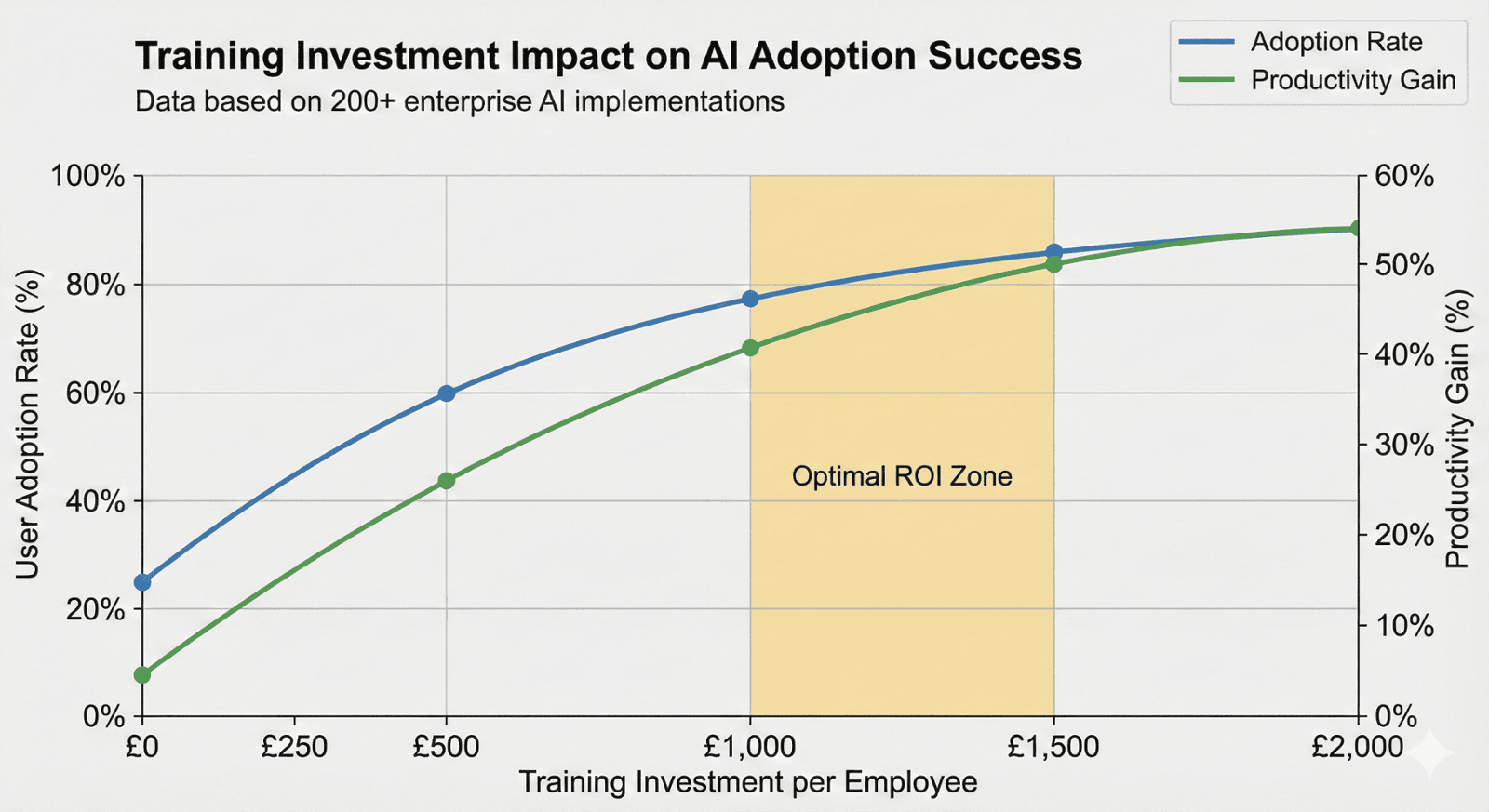
AI projects fail more often due to poor adoption than technical issues. Employees must understand, accept, and effectively use AI tools.
Training Costs:
Basic Training (Tool Usage):
• Online training modules: £50-£150/user (one-time)
• Instructor-led workshops: £500-£1,500/day + £100-£300/participant
• Train-the-trainer programs: £5,000-£25,000
Advanced Training (Strategic Use):
• Department-specific workshops: £2,000-£10,000/session
• Executive briefings: £5,000-£25,000
• Ongoing coaching: £150-£400/hour
Change Management:
• Change management consultant: £150-£350/hour
• Communication strategy: £15,000-£75,000
• Change impact assessment: £10,000-£50,000
• Stakeholder engagement program: £25,000-£150,000
Typical Change Management & Training Costs:
Small Business (10-50 employees):
• Training: £5,000-£25,000
• Change management: £10,000-£40,000
• Total: £15,000-£65,000
Medium Business (50-500 employees):
• Training: £25,000-£150,000
• Change management: £40,000-£200,000
• Total: £65,000-£350,000
Enterprise (500+ employees):
• Training: £150,000-£1,000,000+
• Change management: £200,000-£1,500,000+
• Total: £350,000-£2,500,000+
Common Mistake: Allocating less than 10% of budget to training and change management. Successful projects allocate 15-25%.
Avoid Budget Overruns and Hidden Cost Surprises
Understanding the full cost structure is just the first step. The real challenge is creating accurate budgets for your specific AI initiatives.
This is where expert guidance delivers immediate ROI.
The Consultancy World helps organisations develop realistic AI budgets that account for all cost categories, preventing the shock of unexpected expenses during implementation.
In a complimentary consultation, we'll:
✓ Assess your specific AI objectives and technical environment
✓ Provide detailed cost estimates for your planned initiatives
✓ Identify potential hidden costs specific to your situation
✓ Recommend phased approaches to manage cash flow
✓ Share strategies to reduce unnecessary expenses
Our vendor-agnostic approach ensures recommendations prioritise your success, not vendor commissions.
Category 6: Ongoing Operations and Maintenance
What It Includes:
• System monitoring and performance management
• Model retraining and updates
• Bug fixes and troubleshooting
• Software updates and patches
• Technical support
• Performance optimization
• Security updates
Why Ongoing Costs Matter:
AI systems aren't "set and forget." They require continuous attention to maintain performance, adapt to changing conditions, and address issues.
Annual Operational Costs:
Monitoring and Management:
• AI operations specialist: £55,000-£95,000/year (full-time)
• Monitoring tools: £5,000-£25,000/year
• Performance tracking systems: £10,000-£50,000/year
Model Maintenance:
• Retraining frequency: Quarterly to annually
• Retraining cost per cycle: £5,000-£100,000 depending on complexity
• Annual retraining: £20,000-£400,000
Technical Support:
• Internal support team: £100,000-£500,000/year (depending on size)
• Vendor support contracts: 15-25% of software licensing costs
• Emergency support: £5,000-£50,000/year budget
Optimization and Improvements:
• Ongoing optimisation: £25,000-£250,000/year
• Feature enhancements: £50,000-£500,000/year
• Performance tuning: £10,000-£100,000/year
Typical Annual Operational Costs:
Small Business: £25,000-£100,000/year (25-40% of initial implementation cost)
Medium Business: £100,000-£500,000/year (25-35% of initial implementation cost)
Enterprise: £500,000-£3,000,000+/year (20-30% of initial implementation cost)
Rule of Thumb: Budget 25-35% of your initial AI implementation cost for annual operations and maintenance.
Category 7: Risk Management and Governance
What It Includes:
• AI governance framework development
• Risk assessment and mitigation
• Compliance and regulatory management
• Security audits
• Ethical AI policies
• Insurance and legal review
Why It's Essential:
AI introduces new risks - bias, privacy violations, security vulnerabilities, regulatory non-compliance. Proper governance protects your organisation.
Governance Costs:
Policy Development:
• AI ethics and governance framework: £15,000-£75,000
• Data privacy policies: £10,000-£50,000
• Usage guidelines and standards: £5,000-£25,000
Risk Assessment:
• Initial AI risk assessment: £15,000-£75,000
• Ongoing risk monitoring: £25,000-£150,000/year
• Third-party audits: £25,000-£150,000 annually
Compliance:
• Regulatory compliance review: £15,000-£100,000
• Data protection impact assessment (DPIA): £10,000-£50,000
• Ongoing compliance management: £25,000-£200,000/year
Security:
• AI security assessment: £25,000-£150,000
• Penetration testing: £15,000-£75,000 annually
• Security infrastructure: £50,000-£500,000
Legal and Insurance:
• Legal review of AI implementations: £10,000-£75,000
• AI liability insurance: £5,000-£100,000+/year
• Contract review (vendor agreements): £5,000-£25,000
Typical Governance Costs:
Small Business: £30,000-£100,000 (one-time) + £15,000-£75,000/year
Medium Business: £100,000-£400,000 (one-time) + £75,000-£300,000/year
Enterprise: £400,000-£2,000,000+ (one-time) + £300,000-£1,500,000+/year
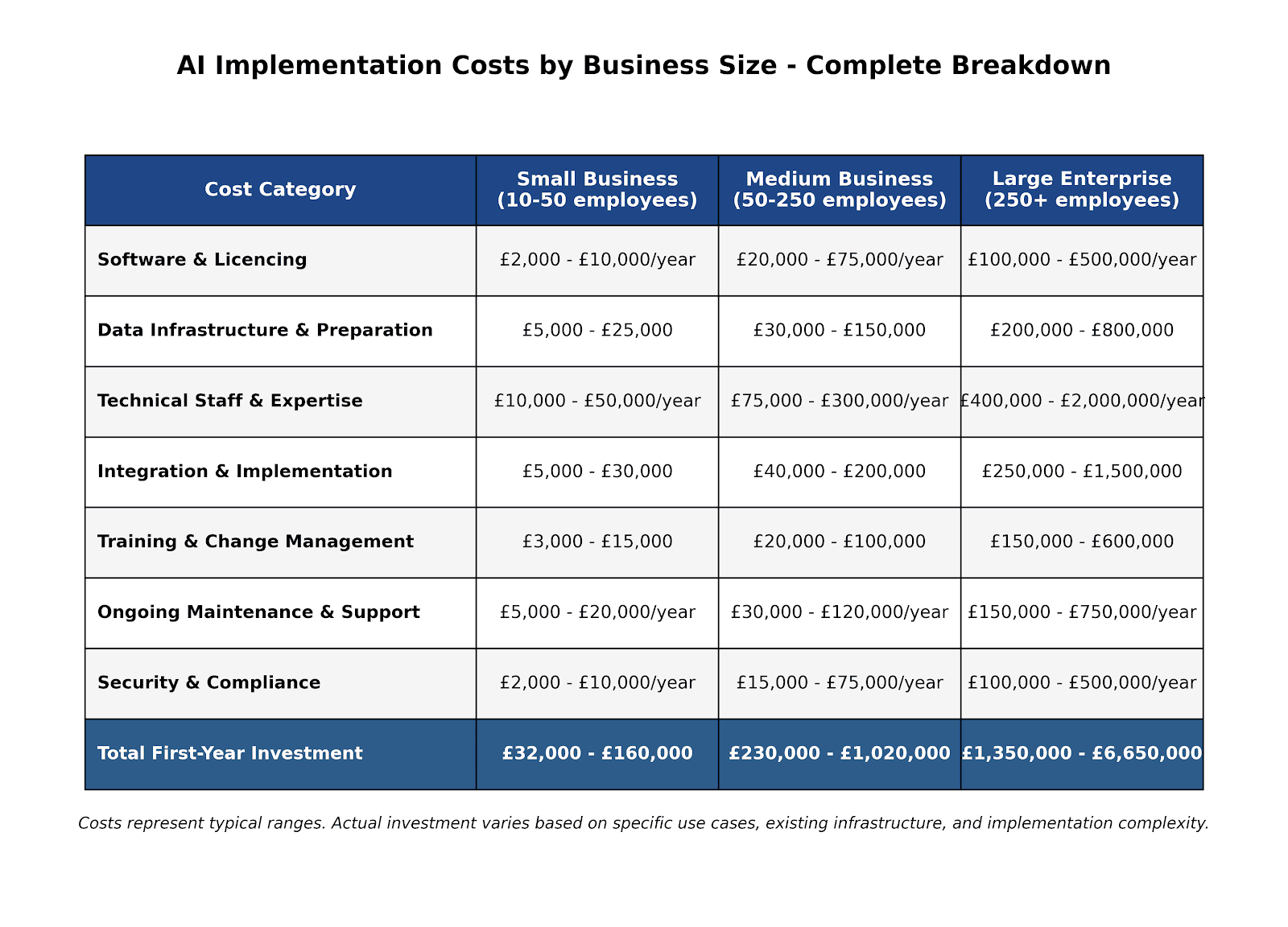
Total Cost Examples: Real-World Scenarios
Understanding complete costs requires examining end-to-end implementations:
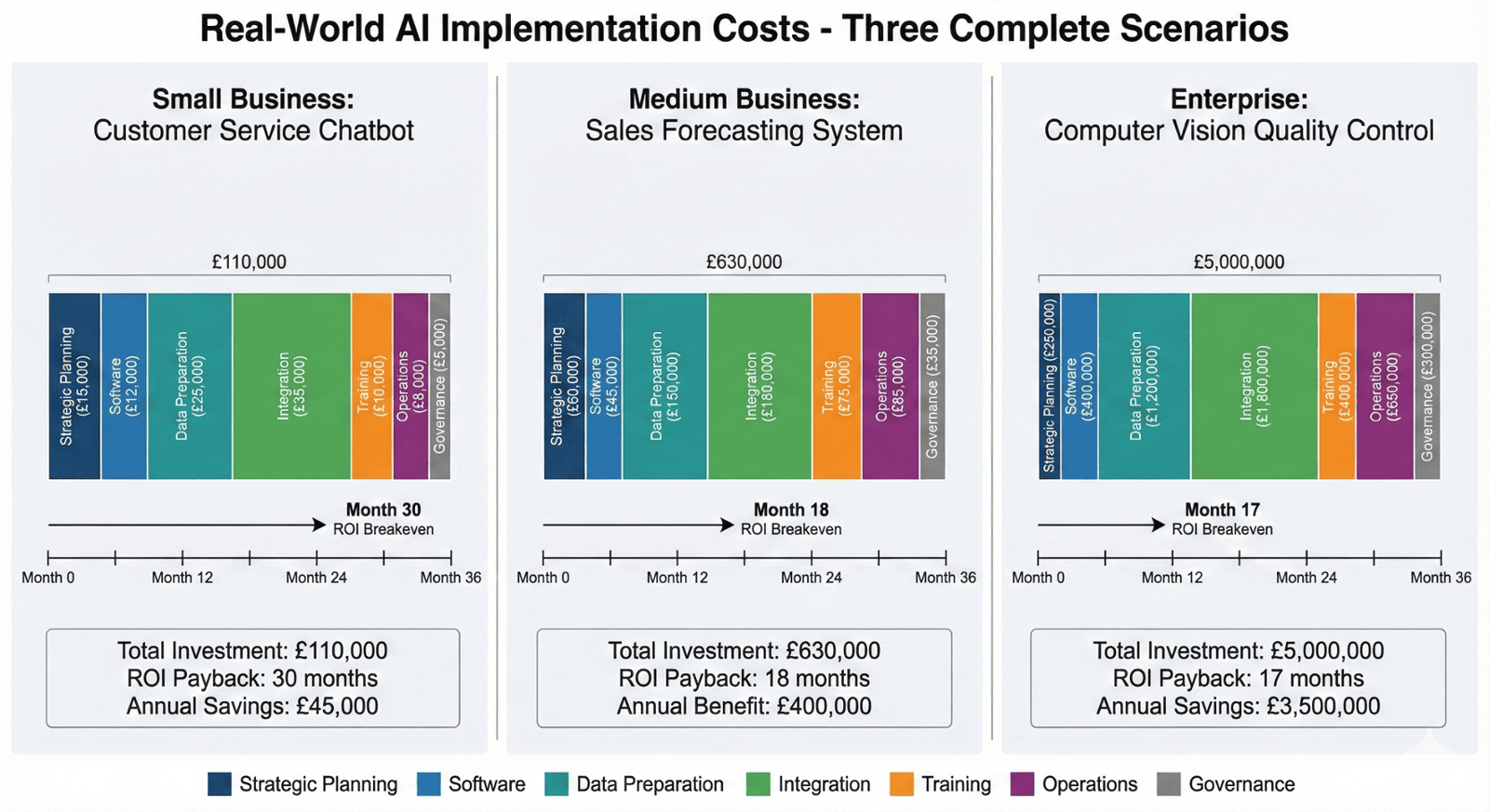
Scenario 1: Small Business Customer Service Chatbot
Business Profile: 25-employee professional services firm, £3M annual revenue
Objective: Automate 60% of routine customer inquiries
Implementation Costs:
1. Strategic Planning: £15,000 (consultant-led assessment and planning)
2. Software: £12,000/year (ChatGPT Enterprise for 10 users)
3. Data Preparation: £25,000 (organize FAQs, customer data, documentation)
4. Integration: £35,000 (connect to ticketing system, website)
5. Training: £10,000 (team training, documentation)
6. Operations: £8,000/year (monitoring, updates, support)
7. Governance: £5,000 (policy development, data privacy)
Total First Year: £110,000
Annual Ongoing (Years 2+): £20,000/year
ROI: Customer service time reduced by 30 hours/week, equivalent savings of £45,000/year. Payback in 2.5 years.
Scenario 2: Medium Business Sales Forecasting System
Business Profile: 200-employee manufacturing company, £35M annual revenue
Objective: Improve sales forecasting accuracy and automate weekly reporting
Implementation Costs:
1. Strategic Planning: £60,000 (comprehensive readiness assessment)
2. Software: £45,000/year (enterprise ML platform)
3. Data Preparation: £150,000 (clean 5 years historical data, infrastructure)
4. Integration: £180,000 (connect to CRM, ERP, financial systems)
5. Training: £75,000 (sales team, leadership, ongoing coaching)
6. Operations: £85,000/year (monitoring, retraining, optimization)
7. Governance: £35,000 (data governance, compliance review)
Total First Year: £630,000
Annual Ongoing (Years 2+): £130,000/year
ROI: 15% improvement in forecast accuracy leads to £400,000 annual benefit through optimised inventory and production planning. Payback in 18 months.
Scenario 3: Enterprise Computer Vision Quality Control
Business Profile: 2,000-employee automotive components manufacturer, £400M annual revenue
Objective: Automated visual inspection on production lines across 3 facilities
Implementation Costs:
1. Strategic Planning: £250,000 (multi-site assessment, ROI modelling)
2. Software: £400,000/year (computer vision platform, cloud computing)
3. Data Preparation: £1,200,000 (image collection, labelling, infrastructure)
4. Integration: £1,800,000 (production line integration, 3 sites)
5. Training: £400,000 (operators, maintenance, quality teams across sites)
6. Operations: £650,000/year (ongoing monitoring, model updates, support)
7. Governance: £300,000 (compliance, safety, quality certifications)
Total First Year: £5,000,000
Annual Ongoing (Years 2+): £1,050,000/year
ROI: Defect detection improved by 40%, reducing warranty claims and recalls by £3,500,000/year. Payback in 17 months.
Hidden Costs: The Budget Killers
Beyond the seven main categories, watch for these often-overlooked expenses:
1. Opportunity Costs
What: Staff time diverted from core responsibilities to support AI implementation
Impact: £50,000-£500,000 in lost productivity
Mitigation: Backfill critical roles, adjust objectives, phase implementations
2. Failed Experiments
What: Pilot projects that don't deliver expected results
Impact: 30-40% of initial AI projects fail or require significant redesign
Mitigation: Proper planning, realistic expectations, agile methodology
3. Technical Debt
What: Quick solutions that require expensive rework later
Impact: Can double long-term costs
Mitigation: Proper architecture planning, avoid shortcuts, document decisions
4. Vendor Lock-In
What: Dependency on specific vendors makes switching expensive
Impact: £100,000-£1,000,000+ to migrate away from entrenched solutions
Mitigation: Choose open standards, maintain vendor optionality, clear exit strategies
5. Scalability Costs
What: Solutions that work for pilots but require complete rebuild to scale
Impact: 2-5x original development costs
Mitigation: Plan for scale from the beginning, prototype with production architecture
6. Compliance Penalties
What: Fines and legal costs from AI-related violations
Impact: £10,000-£10,000,000+ depending on severity and regulation
Mitigation: Build compliance into initial design, regular audits, proper governance
7. Reputation Damage
What: Costs from AI failures, bias incidents, or data breaches
Impact: Impossible to quantify but potentially business-threatening
Mitigation: Rigorous testing, human oversight, transparent operations
Rule of Thumb: Add 20-30% contingency to your total budget for unexpected costs and challenges.
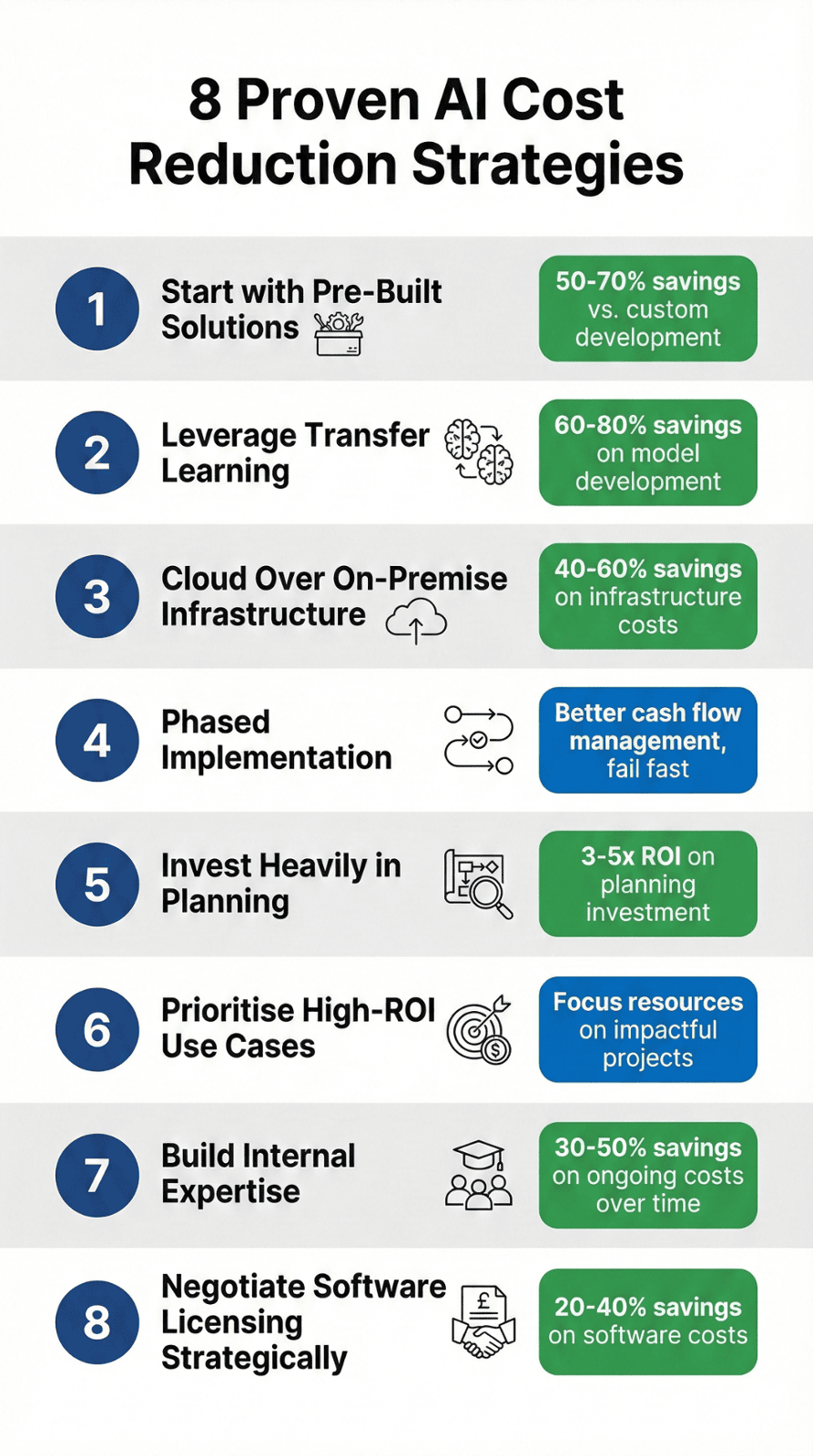
Cost Reduction Strategies That Actually Work
1. Start with Pre-Built Solutions
Savings: 50-70% vs. custom development
Approach: Use existing AI tools (ChatGPT, Microsoft Copilot) before building custom solutions
Trade-off: Less customisation, but much faster implementation and lower risk
2. Leverage Transfer Learning
Savings: 60-80% on model development
Approach: Use pre-trained models and fine-tune for your needs rather than training from scratch
Trade-off: May not achieve absolute optimal performance, but delivers 90% of value at 20% of cost
3. Cloud Over On-Premise
Savings: 40-60% in infrastructure costs
Approach: Use cloud computing instead of purchasing hardware
Trade-off: Ongoing operational costs vs. capital expenditure, less control
4. Phased Implementation
Savings: Better cash flow management, fail fast on poor ideas
Approach: Start with smallest viable pilot, prove value, then expand
Trade-off: Slower to achieve full vision, but dramatically lower risk
5. Invest Heavily in Planning
Savings: 3-5x ROI on planning investment
Approach: Spend 10-15% of budget on strategic planning and assessment
Trade-off: Delayed start, but prevents expensive mistakes
6. Prioritise High-ROI Use Cases
Savings: Focuses resources on impactful projects
Approach: Implement use cases with shortest payback periods first
Trade-off: May not address all opportunities immediately
7. Build Internal Expertise
Savings: 30-50% on ongoing costs over time
Approach: Train internal team rather than permanent external dependency
Trade-off: Higher initial training investment, retention risks
8. Negotiate Software Licensing Strategically
Savings: 20-40% on software costs
Approach: Annual contracts, volume discounts, multi-year commitments with escalation clauses
Trade-off: Reduced flexibility, commitment risk
Make AI Investment Decisions with Confidence
You now understand the complete cost structure of AI implementation - but translating this knowledge into accurate budgets for your specific initiatives requires expertise.
The Consultancy World specialises in helping organisations develop realistic, comprehensive AI budgets that deliver ROI without surprises.
How We Help:
✓ Detailed Cost Modelling
We create line-by-line cost projections for your specific AI initiatives based on your requirements and environment.
✓ ROI Analysis and Business Cases
We model expected benefits against costs, providing realistic payback timelines and financial justifications.
✓ Cost Optimisation Strategies
We identify opportunities to reduce costs without sacrificing value through strategic vendor selection and phased approaches.
✓ Budget Risk Assessment
We highlight areas of cost uncertainty and recommend contingency planning.
✓ Vendor Negotiation Support
Our vendor-agnostic position and industry knowledge helps you negotiate better pricing and terms.
✓ Phased Funding Approaches
We structure implementations to match your cash flow capabilities and prove value before major commitments.
Schedule Your Free Budget Planning Session
In 45 minutes, we'll:
• Review your AI objectives and current environment
• Provide ballpark cost estimates for your planned initiatives
• Identify hidden costs you may not have considered
• Recommend cost-reduction strategies specific to your situation
• Discuss phased approaches to manage investment
No obligations. Just expert financial planning guidance to help you make informed decisions.
Conclusion: Strategic Investment, Not Reckless Spending
AI implementation is a significant investment, but understanding the complete cost structure transforms it from a financial risk into a strategic opportunity.
Key Takeaways:
1. Software costs are typically only 20-35% of total investment. Plan for the full picture from the start.
2. Data preparation and integration often exceed software costs. Don't underestimate these critical activities.
3. Training and change management determine adoption success. Allocate 15-25% of budget here.
4. Ongoing operations are substantial. Budget 25-35% of implementation costs annually.
5. Strategic planning delivers 3-5x ROI. Invest 10-15% of budget in proper planning.
6. Hidden costs can double your budget. Include 20-30% contingency.
7. Phased approaches reduce risk. Start small, prove value, then scale.
The organisations that succeed with AI are those that approach it as strategic investment, not technology experimentation.
Accurate budgeting, realistic expectations, and expert guidance separate successful implementations from expensive failures.
Your next step: Transform cost understanding into strategic financial planning for your AI initiatives.
About The Consultancy World
The Consultancy World provides vendor-agnostic AI strategy consulting, including comprehensive cost modeling and budget planning services. We help organisations avoid the financial pitfalls that derail AI projects.
Our independence ensures our recommendations prioritise your financial success, not vendor commissions or technology trends.
Based in West Sussex, UK | Serving Clients Globally
Need help budgeting for AI initiatives?
Further Reading from The Consultancy World Learning Library
Continue Your AI Education:
• How to Build an AI Strategy That Delivers ROI (Step-by-Step Framework)
• The Difference Between AI Tools and AI Strategy (And Why It Matters)
• Is Your Business AI-Ready? 10 Prerequisites for Successful Integration
This article was written by The Consultancy World's expert team and reflects typical AI implementation costs as of December 2025. Actual costs vary significantly based on specific requirements, industry, and implementation complexity. For accurate cost estimates for your situation, schedule a consultation with our team.
Last Updated: December 18, 2025
Reading Time: 24-28 minutes
Level: Intermediate to Advanced
Audience: CFOs, Finance Directors, Business Leaders, Project Managers
© 2025 The Consultancy for Business Solutions Ltd. All rights reserved. E&OE